
David Whyte
Poet & Philosopher
Trace a path from David Whyte →Portrait painted after an image by Battyefordsands · CC BY-SA 4.0
About
David Whyte (born 1955) is an Anglo-Irish poet and philosopher, born in Mirfield, Yorkshire, to a Yorkshire father and a mother from Waterford. He studied marine zoology at Bangor University and worked as a naturalist in the Galápagos Islands, where he nearly drowned off Hood Island, before leading expeditions in the Andes, the Amazon and the Himalayas. He moved to the United States in 1981 and began working as a poet and speaker in 1986; from 1987 he brought poetry into organizations such as Boeing, AT&T, NASA and Toyota, work he set out in The Heart Aroused (1994). His essays in Consolations (2014) read ordinary words for what they ask of a life. All his poetry and philosophy, he says, rest on one idea: 'the conversational nature of reality.'
Key Contributions
- Grounds his poetry and prose in 'the conversational nature of reality'
- Wrote The Heart Aroused (1994), bringing poetry into the language of work and leadership
- Read everyday words as thresholds in Consolations (2014) and Consolations II
- Founded Many Rivers and Invitas: The Institute for Conversational Leadership
- Worked as a naturalist in the Galápagos before turning to poetry
Close Listening
Videos & Interviews

Inside the Mind of a Master Writer (David Whyte Interview)
David Perell talks with the poet David Whyte about prolonged attention — looking until "the world is paying attention to you" — and about writing from the frontier between what you think is you and what is not. Along the way: why grief and anger are forms of care, how memorizing poetry line by line changes what you see, how to find a beautiful question, and why, in the end, it is always about love.
View Details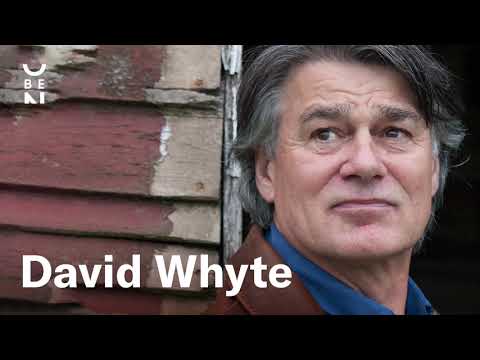
David Whyte – The Conversational Nature of Reality
Krista Tippett talks with the poet David Whyte, in a 2016 conversation for On Being, about the idea under all his work: that reality is conversational, and the only real place is the frontier between what you think is you and what is not. He traces it to two years of attention as a naturalist in the Galápagos, where he found his identity depended on how closely he watched things other than himself. From there: poetry as "language against which you have no defenses," vulnerability as something we can only choose how to inhabit, grief for his friend John O'Donohue, genius as the way everything has met in you, and the discipline of asking beautiful questions in unbeautiful moments. He recites "Everything Is Waiting for You" and "Sweet Darkness" from memory.
View DetailsConnections

John O'Donohue
Influenced byPoet & Philosopher
Close friends, and by Whyte's account two halves of one voice: 'I'm a poet-philosopher, he would have been a philosopher-poet, and we were like two bookends.' When O'Donohue died, 'the other half of me disappeared'; since then Whyte will start a sentence and feel John finish it. He still teaches from O'Donohue's words — the 'radical letting alone of yourself and the world', and the shaping of 'a more beautiful mind', which Whyte made his own discipline of asking beautiful questions.
youtube.com · youtube.com · youtube.com

Albert Camus
KindredWriter & Philosopher of the Absurd
A pairing Whyte makes in passing and means. Explaining why weeping is a body growing large enough to hold what it has seen, he reaches for Camus — 'a great and loving imperative: live to the point of tears' — and insists it is not sentimentality but an invitation to feel everything, in beauty and in sorrow, without a barrier. Camus's lucid refusal to look away from the absurd and Whyte's refusal to look away from grief ask the same discipline of attention.
youtube.com

David Abram
KindredCultural Ecologist & Philosopher
Read as a pairing: two former field naturalists who came back with the same report. Whyte learned it guiding in the Galápagos, where the animals have no fear of people — 'if you are paying attention to the world, you suddenly realize the world is paying attention to you.' Abram builds a philosophy of perception on that reciprocity; Whyte builds a poetics on it and calls it the conversational nature of reality.
youtube.com

John Vervaeke
KindredCognitive Scientist & Philosopher
An interpretive pairing between a poet and a cognitive scientist who refuse the same split. Whyte says all his work rests on 'the conversational nature of reality'; Vervaeke argues that what matters to us is neither in the mind nor out in the world but 'thrown between', a real relation he calls transjective. Whyte speaks from the frontier 'between what you think is you and what is not you'; Vervaeke's argument says that frontier is where meaning lives.
en.wikipedia.org · youtube.com · youtube.com

David Foster Wallace
KindredNovelist & Essayist
Both make attention a moral act. Wallace told Kenyon's graduates that learning how to think means being 'conscious and aware enough to choose what you pay attention to'; Whyte asks for attention held 'until the name you've given to something breaks down and the essence speaks back.' Wallace speaks from inside the default self-centredness he is fighting, Whyte from its far side, where the one paying attention disappears.
fs.blog · youtube.com

