
Richard Sutton
Founder, Oak Lab & Professor, University of Alberta
About
Richard Sutton is the father of modern reinforcement learning, winner of the 2024 Turing Award with his doctoral advisor Andrew Barto, and — as of 2026 — founder of Oak Lab, a Toronto lab pursuing agents that learn continuously from raw experience. A psychology BA before computer science, he built the field's conceptual core across four decades: temporal-difference learning, policy gradients, the Dyna architecture, the options framework, and the textbook that taught RL to everyone. His 2019 essay 'The Bitter Lesson' — general methods that leverage computation beat human-knowledge engineering, every time — became the most-cited two pages in modern AI. He spent 2017–2023 at DeepMind Alberta, then partnered with John Carmack at Keen Technologies, and now argues that LLMs are a detour: intelligence comes from experience, not from imitating human text.
Key Contributions
- Built the algorithmic foundations of reinforcement learning — temporal-difference learning, policy gradient methods, Dyna, and the options framework — honored with the 2024 Turing Award, shared with Andrew Barto
- Co-authored Reinforcement Learning: An Introduction (1998; 2018), the textbook that defined the field for two generations
- Wrote The Bitter Lesson (2019), two pages arguing that general methods leveraging computation always win — modern AI's most quoted essay
- Authored the Alberta Plan and OaK architecture — a roadmap for superintelligence from continual, run-time experience
- Founded Oak Lab (2026) with Khurram Javed after leaving Keen Technologies, betting his Turing Award credibility that frozen LLMs are a dead end
Videos & Interviews
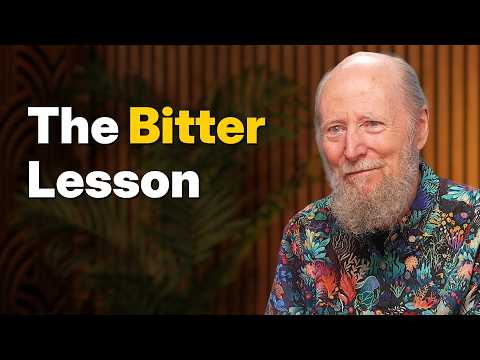
Richard Sutton – Father of RL thinks LLMs are a dead end
The interview that detonated AI Twitter. Fresh off the Turing Award, Sutton tells Dwarkesh Patel that large language models cannot learn on the job, cannot predict the world, cannot be surprised — and therefore cannot be the path. Patel pushes back from inside the scaling worldview, and for an hour the two talk past each other in the most instructive way possible: what you are hearing is the field's deepest fault line, between intelligence as imitation of human text and intelligence as experience. Sutton's verdict afterward: "a frank exchange of views."
View Details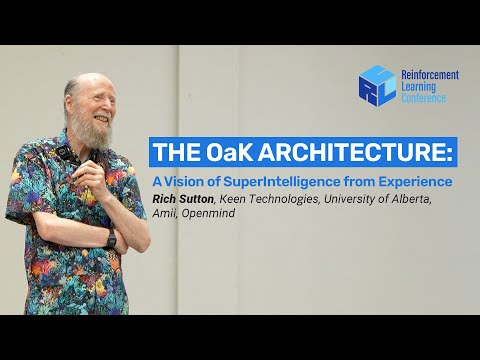
The OaK Architecture: A Vision of SuperIntelligence from Experience
The constructive half of Sutton's refusal. If LLMs are a dead end, what is the road? His RLC 2025 keynote lays out OaK — Options and Knowledge — an architecture where an agent builds its own abstractions from run-time experience: no pretraining corpus, no human-curated knowledge, everything learned one step at a time from the stream of life. This is the talk that became a lab: within a year of giving it, Sutton left Keen Technologies and founded Oak Lab to build exactly this.
View DetailsConnections

Jeff Clune
InfluencedProfessor, University of British Columbia
Clune's AI-GAs manifesto opens its argument with Sutton: 'As Richard Sutton has recently pointed out, history has shown that the algorithms that tend to win over the long haul are simple ones that can take advantage of massive amounts of computing.' The Bitter Lesson said stop hand-coding knowledge; Clune extended it one turn of the crank — stop hand-designing the learning algorithms themselves. 'Don't invent faster horses' is the Bitter Lesson taken to its limit.
arxiv.org · incompleteideas.net

Yann LeCun
In contrastChief AI Scientist, Meta
The field's two most decorated LLM skeptics, whose alternatives point in opposite directions. LeCun's famous cake put reinforcement learning as the cherry on top — a garnish on a foundation of learning by observation; Sutton's whole career says the cherry is the cake, that reward and experience are where intelligence comes from. They agree the current paradigm is a detour and disagree, almost perfectly, about the road.

Andrej Karpathy
In contrastAI Researcher & Educator
When Sutton told Dwarkesh Patel that LLMs are a dead end, Karpathy answered with an essay: we are not building animals that learn from the world, we are summoning ghosts distilled from humanity's text — and the ghost is a practical answer to the cold-start problem the animal has never solved. Sutton holds the pure position; Karpathy the engineer's amendment. Between them runs the field's live question: is pretraining a foundation, or a ceiling?
karpathy.bearblog.dev

Gary Marcus
In contrastCognitive Scientist, AI Critic & Author
Both say LLMs will not reach real intelligence — for reasons that cancel each other out. Marcus diagnoses too little built-in structure: minds need innate machinery that pure learning cannot supply. Sutton's Bitter Lesson diagnoses the opposite disease: every hand-built structure is a mortgage against scale, and experience alone should build the machinery. The shared conclusion makes the opposite premises easy to miss — which is exactly why the pairing teaches.

