
關於
Benjamin Bratton 是科技哲學家,任加州大學聖地牙哥分校科技哲學與思辨設計教授,並創立該校的思辨設計(Speculative Design)大學部主修。他的著作《The Stack: On Software and Sovereignty》(MIT Press,2016)把行星尺度的運算視為一個整體結構,分成地球、雲端、城市、位址、介面與使用者六層。他主持智庫 Antikythera,研究行星運算與智能的演化;Antikythera 於 2022 年在 Berggruen Institute 內孵化成立,2026 年起獨立運作。2022 年他與 Blaise Agüera y Arcas 在《Noema》合寫〈The Model Is the Message〉,主張語言模型的能力已經超出我們用來描述它們的語彙。他自 2024 年起在 Google 的 Paradigms of Intelligence 研究團隊擔任訪問研究員;2026 年 6 月,Antikythera 成立研究單位 Agentworld,探討人類與 AI agent 共同組成的社會。
主要貢獻
- 《The Stack: On Software and Sovereignty》(MIT Press,2016),把行星尺度運算描繪成從地球到使用者的六層結構
- 創辦並主持行星運算與智能演化智庫 Antikythera(2022)
- 與 Blaise Agüera y Arcas 合著〈The Model Is the Message〉(Noema,2022),談語言模型跑在我們的概念前面
- 《The Revenge of the Real: Politics for a Post-Pandemic World》(Verso,2021)
- 成立 Antikythera 的 Agentworld 研究單位(2026),研究人類與 AI agent 組成的社會
影片與訪談

Audrey Tang, Benjamin Bratton | Gray Area Festival 2021
The opening conversation of Gray Area Festival 2021, recorded on 6 October 2021 and built around Bratton's The Revenge of the Real. It is about governance and digital public infrastructure rather than AI. Starting from Facebook's outage and leaks, Tang argues that Taiwan's civic discussion runs on commons such as PTT rather than Facebook, and explains its pandemic response without lockdowns as maximal trust in the social sector: the 1922 hotline, SMS check-ins held by telecoms and deleted after 28 days, and "humour over rumour" memes answering disinformation within two hours. Bratton reads the pandemic as a crisis of Western governance, and argues that California's problem was too little sensing, not too much surveillance.
View Details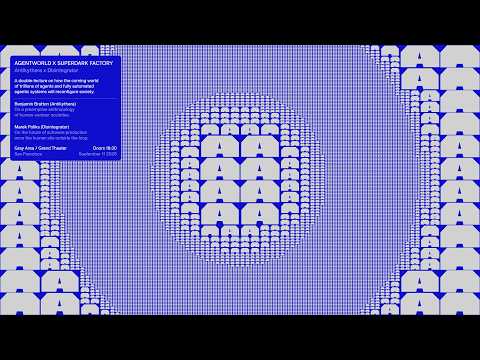
Agentworld x Superdark Factory — Antikythera x Disintegrator
A double lecture at Gray Area launching Antikythera's Agentworld journal issue. Bratton says his lab's p(doom) is very low and its p(weird) very high, and sets "agency theater" (people performing a control they lack, like the disconnected close-door button in an elevator) against AI agents with much agency and little subjectivity. He rejects a "humanity of the gaps" view in which every AI gain shrinks the human, argues that agent societies need intelligent institutions rather than only well-behaved agents, and warns that fear of AI is turning into an artificial xenophobia. Marek Poliks of Disintegrator then sorts automation into three classes by what a machine takes as input, and argues that a factory which sets its own objectives can be steered only through its initial conditions, making its governance a problem of game theory.
View Details

