
John Searle
Philosopher of Mind & Language
關於
John Searle (b. 1932) is an American philosopher whose 1980 Chinese Room argument became the most-debated objection to machine understanding ever posed: a person following rules to manipulate Chinese symbols can pass for a speaker while understanding nothing, so syntax alone cannot produce semantics. Earlier, his work on speech acts showed how saying is a kind of doing. His 'biological naturalism' holds that consciousness is a real, causal, biological phenomenon — neither reducible to computation nor separate from the brain.
主要貢獻
- Posed the Chinese Room argument (1980), the canonical challenge to the claim that symbol manipulation amounts to understanding
- Developed speech act theory, showing how utterances perform actions rather than merely describe
- Articulated biological naturalism: consciousness as a causal, biological feature of brains
- Distinguished 'strong AI' from 'weak AI', vocabulary the debate still uses
- Kept the syntax/semantics distinction at the center of machine-understanding debates for four decades
影片與訪談
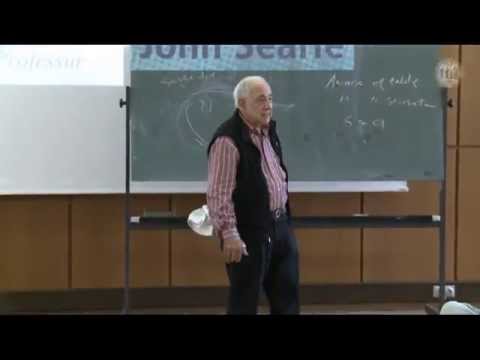
John Searle // Seminar: "Perception and Intentionality"
Searle's seminar from his 2013 Albertus Magnus Professorship at the University of Cologne, one of three themes he took up there alongside "Language and Social Ontology" and "Mind and Brain". The territory is his direct-realist account of perception: perceptual experience is intentional, its conditions of satisfaction are causally self-referential, and satisfying them means seeing the object itself rather than a picture of it. The material became *Seeing Things as They Are* (2015).
View Details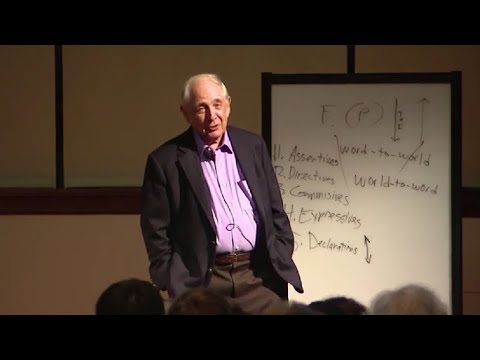
The Logical Structure of Human Civilization (John Searle)
In this Patten Lecture at Indiana University, Searle lays out his social ontology: money, property, marriage, and government exist only because we collectively declare them into being through speech acts. Human civilization, unlike animal society, is built and held together by linguistic representation with logical, propositional structure.
View Details論文與出版物
思想連結

丹尼爾·丹尼特
觀點交鋒哲學家與認知科學家
他們的爭執是中文房間辯論的脊椎。Hofstadter 與 Dennett 在《The Mind's I》裡重印了 Searle 1980 年的論證,並附上反駁;Searle 在《紐約書評》評論該書,兩人於 1982 年的〈The Myth of the Computer: An Exchange〉往返交鋒,到了 1995 年又為《Consciousness Explained》再戰一回。Dennett 說那個房間是一具直覺幫浦,它之所以有效,只因為它誘使你想像一個過於簡單的案例;Searle 則回答:再多的語法,也永遠變不成語意。
nybooks.com · nybooks.com · plato.stanford.edu

David Chalmers
觀點交鋒心智哲學家
Searle 在《紐約書評》(1997 年 3 月)評論《The Conscious Mind》,指其立場自相矛盾——把性質二元論硬接在功能主義上,還一路滑向泛心論;Chalmers 在同年 5 月的交鋒中回應:他只是探討泛心論,並未背書,而性質層次的二元論恰恰讓「什麼基質能承載意識」這個問題完全敞開。這場爭論的賭注是機器形狀的:在 Chalmers 看來,矽並未被排除;而對 Searle 而言,意識是大腦這種生物達成的成就。
nybooks.com · consc.net

Emily Bender
思想同道Computational Linguist
一組跨越四十年的詮釋性對照:Searle 的中文房間與 Bender 的章魚,問的都是同一件事——一個能完美操作符號的系統,對這些符號的意義究竟有沒有著力點。差別在於論證的力量從哪裡來。Searle 是先驗的論證,關乎意向性、關乎一個程式原則上永遠不可能擁有什麼;Bender 則以語言學家的身分追問:一份純粹由形式構成的語料,能提供什麼、不能提供什麼。一個說那個房間永遠不會理解;另一個說,沒有人指得出意義是從哪裡進去的。

Hubert Dreyfus
思想對照哲學家與 AI 批評者
這是對兩位柏克萊同事的一種讀法:他們攻擊同一個目標,路徑卻互不相容。Searle 承認程式或許能通過圖靈測試,但否認它理解任何東西——語法永遠變不成語意。Dreyfus 否認的是更前面那一步:一個只被餵養明確規則的系統,根本應對不到那個程度,因為專家的本事不是規則。一種論證讓出了行為、卻扣住了心智;另一種則說,那種行為壓根不會出現。
plato.stanford.edu

