
Blaise Agüera y Arcas
VP & Fellow, Google
About
Blaise Agüera y Arcas is a Vice President and Fellow at Google, where he leads teams working on AI and machine intelligence. Previously at Microsoft, he created Photosynth and was a Distinguished Engineer. At Google, he has led efforts on on-device machine learning, federated learning (privacy-preserving distributed ML), and more recently on large language models. He is known for his interdisciplinary approach, connecting AI with neuroscience, art, and social systems.
Key Contributions
- Created Photosynth at Microsoft, making large-scale photo collections navigable as reconstructed spatial environments
- Helped architect Bing Maps and Bing Mobile, shaping how large-scale visual data became everyday navigation infrastructure
- Helped lead on-device and privacy-preserving ML at Google, including work connected to federated learning
- Writes and researches across AI, neuroscience, evolution, and creativity, resisting a narrow engineering-only account of intelligence
- Publicly explores machine creativity and possible machine consciousness before those questions became mainstream AI discourse
- His speculative openness is valuable, though critics can see it as moving faster philosophically than the evidence warrants
Questions they sharpened View the streams
Does an LLM actually understand?
2022Yes — and it's relational. Understanding takes two. The people who deny that models understand, while relying on them to grasp their meaning and follow directions, are applying a double standard; the supposed gap between real and mere understanding is a metaphysical assumption, not an observation.
Where does agency come from?
2024Purpose emerges from purposelessness. Seed a soup with random self-modifying programs and self-replicators arise unbidden, growing complex not by random search but by symbiogenesis — you can watch purpose appear with nothing purposeful behind it.
Are we separate from our machines?
2026We merged with machines a long time ago. Life uses technology all the way down, and we've co-evolved with ours past the point of subject and object — there is no clean, separate 'us,' set apart from our machines, waiting to be protected or replaced.
Could an LLM be conscious?
2026'Is it conscious?' is a badly-posed question. Consciousness is relational — a matter of relating, of modeling others and modeling yourself. Asking in the absolute whether a system is conscious is like asking whether the Russian or the English word for green is the correct one.
Does information carry meaning?
2026There is live information and dead information. DNA in a living cell is a code with causal power — Bateson's 'a difference that makes a difference'; the same molecule in a dead cell is only Shannon bits. Information means something only while something is computing with it.
What is technology?
2026We merged with machines a long time ago. Technology isn't opposed to life — like life it grows by symbiogenesis, every tool a combination of earlier tools (no spear before the stone point), and we've co-evolved with it past the line of subject and object.
Would superintelligence be dangerous by default?
2026The tale of a superintelligence climbing a dominance hierarchy and wiping us out is implausible. Intelligence arises to model others and enter symbiosis with them, not to dominate; machines are already in deep symbiosis with us. The real danger is our own ideology, not a mind that outsmarts us.
Videos & Interviews
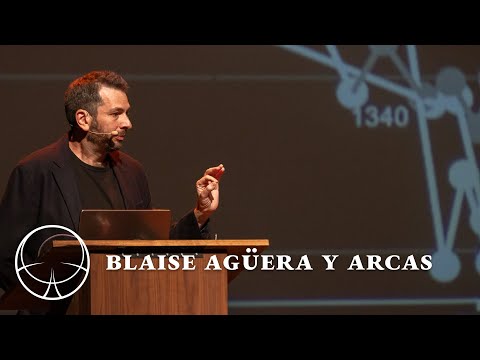
Blaise Agüera y Arcas | What is Intelligence? | Long Now Talks
Long Now Foundation talk exploring the nature of intelligence
View Details
How computers are learning to be creative | Blaise Agüera y Arcas
TED Talk on neural networks and machine creativity
View Details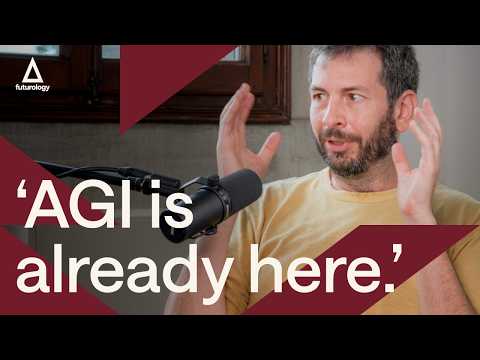
We Merged With Machines a Long Time Ago | Google's Blaise Agüera y Arcas & Physicist Carlo Rovelli
Berggruen "Futurology" dialogue in which Blaise Agüera y Arcas makes the case to physicist Carlo Rovelli that artificial general intelligence has already arrived — tracing intelligence back to modeling others and cooperating to survive, and arguing the human–machine merger is not coming but is how we got here.
View DetailsConnections

Emily Bender
DebatedComputational Linguist
In December 2021 Agüera y Arcas published 'Do large language models understand us?', arguing that statistics do amount to understanding in any falsifiable sense; Bender answered in January with a line-by-line rebuttal that rejected both the claim and his analogies between language models and blind and Deafblind people. It is the live version of the argument her octopus test had staged in the abstract: one side holds that meaning requires grounding outside the text, the other that understanding was always relational and that denying it to models is a double standard. This site's question 'Does an LLM actually understand?' carries both of their cuts.
medium.com · medium.com · aclanthology.org

Gary Marcus
DebatedCognitive Scientist, AI Critic & Author
In October 2023 Agüera y Arcas and Peter Norvig argued in Noema that artificial general intelligence is already here, since frontier models competently handle tasks they were never trained for. Marcus, writing with Ernest Davis a week later, called it an epic act of goal-post shifting and listed purely language-based tasks the models still cannot do. The disagreement is less about capability than about who is entitled to set the threshold — which is why 'has AGI arrived' keeps collapsing into 'what did you mean by the word.'
garymarcus.substack.com · noemamag.com

Joscha Bach
KindredAI Researcher & Cognitive Scientist
The two technologists in this atlas most willing to treat machine consciousness as an engineering-tractable question — and they arrived independently: Bach through cognitive architectures and his machine-consciousness hypothesis, Agüera y Arcas through large models at Google and computational functionalism. They share this site's lens on 'Could an LLM be conscious?', both answering: in principle, why not.

Jeff Clune
KindredProfessor, University of British Columbia
Two researchers convinced that intelligence is grown, not engineered. Agüera y Arcas showed that self-replicating programs emerge unbidden from random bytes ('Computational Life', 2024); Clune builds Darwin-complete environments meant to keep generating novelty forever. Both treat the origin of life as the best available case study for the origin of minds — and both suspect the field's hand-designed architectures are a detour around the only process known to have worked.

