
Daniel Dennett
Philosopher & Cognitive Scientist
About
Daniel Dennett (1942–2024) was one of the most influential philosophers of mind and cognitive science. His work on consciousness, free will, and evolution shaped how we think about minds—both biological and artificial. His 'multiple drafts' model of consciousness and concept of the 'intentional stance' remain central to debates about whether AI systems can truly be conscious or merely simulate understanding. A fierce critic of what he called 'the Cartesian theater,' he argued that consciousness is not a single unified experience but an emergent property of many parallel processes.
Key Contributions
- Developed the intentional stance, explaining how treating systems as belief-and-desire agents can be predictively useful
- Rejected the 'Cartesian theater' and proposed the multiple-drafts model of consciousness in 'Consciousness Explained'
- Used evolution and computation to naturalize mind, free will, and meaning without invoking a central inner observer
- Wrote 'Darwin's Dangerous Idea' and 'Breaking the Spell,' bringing evolutionary explanation into debates over culture, religion, and agency
- Gave AI debates a way to ask when agency is a useful explanatory stance rather than a hidden essence
- His deflationary view of consciousness is influential but fiercely disputed by philosophers who think it explains away lived experience
Questions they sharpened View the streams
What is consciousness?
The 'something it is like' is a user illusion — a story the brain tells itself about itself.
How does a mind know what matters?
1984A robot that must check whether each fact is relevant before it acts never acts — it vanishes into an infinite lobby of considerations. Deciding what to ignore is the whole problem, and it is not obviously solvable by more computation.
What are we talking to when we talk to an LLM?
1987Whatever you are addressing is picked out by the intentional stance: treat it as a system with beliefs and desires exactly insofar as doing so predicts what it does. The interlocutor is the pattern that stance makes visible — no inner verdict required.
What is agency?
1987Something is an agent when predicting it as one works better than predicting it as a mechanism — the intentional stance.
Does reality descend or emerge?
1995There are no skyhooks — no higher mind reaching down to do the lifting. Every scrap of order is raised by cranes: mindless, bottom-up processes stacked on one another until competence and even purpose appear, with nothing purposeful underneath.
Books


Videos & Interviews
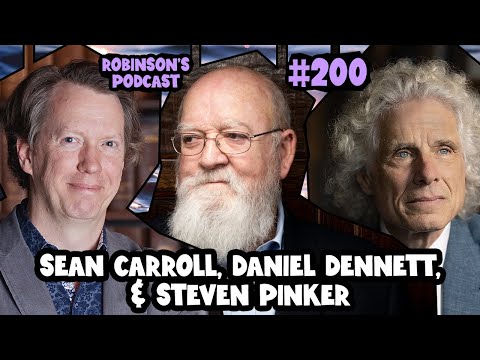
Sean Carroll, Daniel Dennett, & Steven Pinker: AI, Parapsychology, Panpsychism, & Physics Violations
A wide-ranging discussion with physicist Sean Carroll, philosopher Daniel Dennett, and cognitive scientist Steven Pinker on AI, parapsychology, panpsychism, and what would count as a violation of physics.
View Details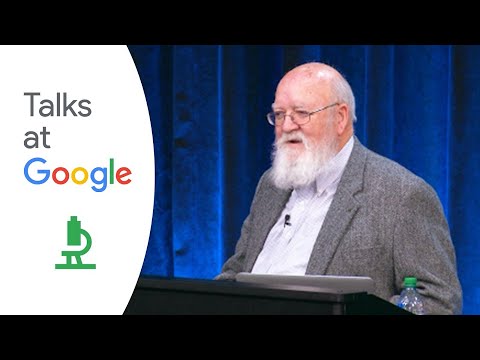
Daniel Dennett: From Bacteria to Bach and Back
Talks at Google - Dennett on how comprehending minds arise from mindless natural selection
View Details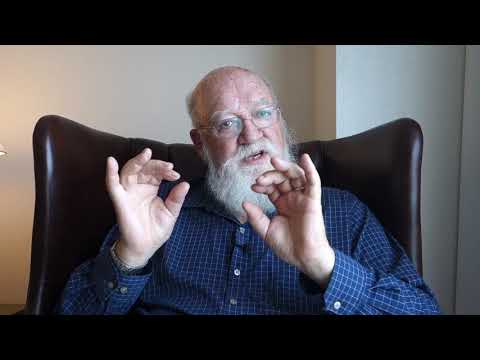
Daniel Dennett - Information & Artificial Intelligence
A Daniel Dennett talk on information, meaning, and artificial intelligence, including how simple biological systems help ground semantics and how those ideas scale up into human cognition and AI.
View Details
The illusion of consciousness | Dan Dennett
TED Talk on why we think we understand consciousness when we don't
View DetailsConnections

John Searle
DebatedPhilosopher of Mind & Language
Their quarrel is the spine of the Chinese Room debate. Hofstadter and Dennett reprinted Searle's 1980 argument in The Mind's I with a rebuttal attached; Searle reviewed that book in the New York Review of Books and the two traded letters in 'The Myth of the Computer: An Exchange' (1982), and were still at it in 1995 over Consciousness Explained. Dennett calls the room an intuition pump that works only by getting you to imagine too simple a case; Searle answers that no quantity of syntax ever becomes semantics.
nybooks.com · nybooks.com · plato.stanford.edu

Charles Darwin
Influenced byNaturalist & Originator of Evolution by Natural Selection
Dennett's late career is one long argument that Darwin's idea is not about beetles. Darwin's Dangerous Idea (1995) reads natural selection as 'a substrate-neutral, mindless algorithm for moving through Design Space' — a universal acid that eats through every account of design reaching down from above, leaving cranes where the skyhooks were. From Bacteria to Bach and Back (2017) closes the loop this site keeps circling: competence without comprehension, sophisticated action with nobody inside who understands why it works. Written about evolution, read today it describes something else that got good at things without being told how.
en.wikipedia.org · Darwin's Dangerous Idea: Evolution and the Meanings of Life (Simon & Schuster, 1995) · en.wikipedia.org · youtube.com

David Chalmers
DebatedPhilosopher of Mind
The zombie is the hinge. Chalmers argues that a being functionally identical to you but with no inner experience is at least conceivable, which would show experience is a further fact beyond function; Dennett replies in 'The Unimagined Preposterousness of Zombies' (1995) that philosophers who claim to conceive one have simply not done the imagining. Chalmers' 'Moving Forward on the Problem of Consciousness' answers back, naming Dennett as the one philosopher who explicitly denies there is a hard problem at all.
dl.tufts.edu · consc.net

Sean Carroll
KindredHomewood Professor of Natural Philosophy, Johns Hopkins University
Two versions of the same deflationary move. Dennett explains consciousness by explaining away the demand for an inner theater; Carroll's poetic naturalism explains meaning and purpose by granting that many vocabularies can be true of one world, each at its own level. Both refuse the extra ingredient without denying that the thing being described is real — a position that is easy to mistake for eliminativism and is not. They appear together, with Steven Pinker, in a recorded panel on this site.
youtube.com

