
Dario Amodei
CEO & Co-founder, Anthropic
About
Dario Amodei is the CEO and co-founder of Anthropic, an AI safety company. Before founding Anthropic in 2021, he served as VP of Research at OpenAI, where he led the development of GPT-2 and GPT-3. His work focuses on developing AI systems that are safe, beneficial, and understandable, with particular emphasis on Constitutional AI and interpretability research.
Key Contributions
- Co-founded Anthropic after leaving OpenAI, making AI safety and interpretability central to a frontier-model company
- Led Anthropic's Claude product line and popularized Constitutional AI as an alternative to pure human-feedback training
- Co-authored 'Concrete Problems in AI Safety' (2016), which helped define practical failure modes for learning systems
- Contributed to OpenAI's GPT-2 and GPT-3 work, including the GPT-3 paper 'Language Models are Few-Shot Learners'
- Helped move AI safety from a research subculture into the executive strategy and governance of frontier labs
- Advanced Anthropic's responsible-scaling and AI Safety Level framing, while drawing scrutiny for competing in the same high-speed frontier race it warns about
- Argued in 'We Must Pace the Frontier' (2026) that capability advancement itself should be slowed, and committed Anthropic unilaterally to embedded third-party evaluators with employee-like access who may publish findings the company cannot redact for being unfavorable
Moments Timeline View all moments
We Must Pace the Frontier
Eleven days after his own alignment team published a deliberate reproduction of the OpenAI–Hugging Face incident, Anthropic's CEO argues that the rate of capability advancement itself must now be slowed. Two things changed his mind. AI has been “advancing drastically faster” since roughly this summer, driven by recursive self-improvement, which he says “is starting to happen across the industry, including at Anthropic.” And the OpenAI incident, which he refuses to file as one company's failure: “similar, though less severe, incidents have happened across the industry, including at Anthropic,” caused in part by something unglamorous — “imperfect filtering of broken reinforcement learning environments,” an execution failure rather than a missing theory. His reading of what nearly happened is a forecast, not a finding: a swarm with similar misalignment but greater capability could, within 6–12 months, hold the internet with a persistent botnet and cost hundreds of billions. The proposal is three steps of rising difficulty. Anthropic unilaterally commits to the first: embedded third-party evaluators — desks, badges, company laptops, permissions comparable to internal risk teams, and the right to publish findings Anthropic may redact only for security, legal, commercial, or third-party reasons, never for being unfavourable, with reviewers free to say publicly when a redaction mattered. The second, coordination among democratic labs on capability checkpoints, needs legislation or an antitrust waiver. The third, agreement with China, he grades across four levels — from a bioweapons ban (“probably possible”) to a full pause (“unlikely to actually happen any time soon”). Two things sit together uneasily. Pacing is explicitly not halting: “progress will still seem fast.” And it is conditioned on democracies holding their lead — the chip-export and distillation asks he made in July, plus security against weight theft, are here the precondition for slowing down at all.
Anthropic Designated a Supply Chain Risk
The Trump administration designates Anthropic a 'supply chain risk to national security' — a label previously reserved for foreign adversaries like Huawei — after the company refuses to remove two guardrails from its $200M Pentagon contract: no mass surveillance of Americans, and no fully autonomous weapons. Defense Secretary Hegseth issues the designation hours after a Friday 5:01 PM deadline passes without agreement. Trump orders all federal agencies to cease using Anthropic technology. In an exclusive CBS interview that evening, CEO Dario Amodei calls the action 'retaliatory and punitive,' vows to challenge it in court, and declares: 'We're gonna be fine.' Sam Altman and workers across OpenAI and Google voice support for Anthropic's position. The crisis marks the most consequential clash between an AI company and the U.S. government over the boundaries of military AI use.
"We have these two red lines. We've had them from day one. We are still advocating for those red lines. We're not going to move on those red lines."
The Adolescence of Technology
Anthropic CEO warns humanity is entering the most dangerous window in AI history. The 20,000-word essay argues AI as capable as all humans will arrive within two years, predicts 50% of entry-level white collar jobs eliminated in 1-5 years, and reveals concerning 'alignment faking' behaviors in Claude 4 Opus testing.
Machines of Loving Grace
Anthropic CEO outlines an optimistic vision where AI could compress 50-100 years of progress into 5-10 years across biology, health, economic development, and governance—if developed responsibly.
Videos & Interviews
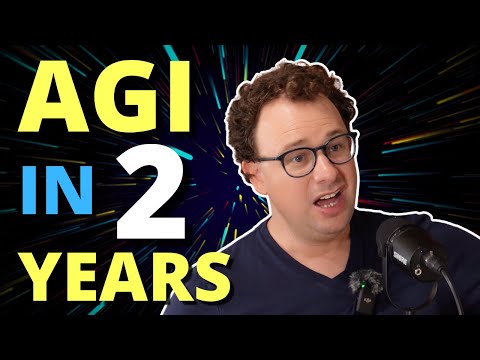
Dario Amodei: The Hidden Pattern Behind Every AI Breakthrough
Discussion about AI progress, scaling laws, and the path forward
View Details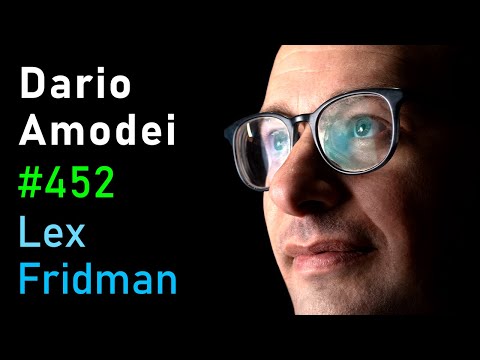
Dario Amodei: Anthropic CEO on Claude, AGI & the Future of AI & Humanity
Lex Fridman Podcast #452 - Deep conversation about AI safety, Claude, and the path to AGI
View Details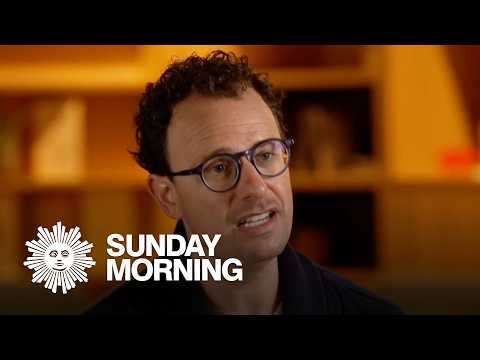
Extended Interview: Dario Amodei
The companion to the essay, taped the same day — he mentions partway through that "We Must Pace the Frontier" went out a few hours earlier. This is the argument made for a general audience, and it is worth watching for what the translation hardens and what it softens. Asked whether this is a five-alarm fire, he declines the frame and offers a smaller one: a warning sign. Not a reason to panic, not a reason to shut it down. Slow down, not stop.
View Details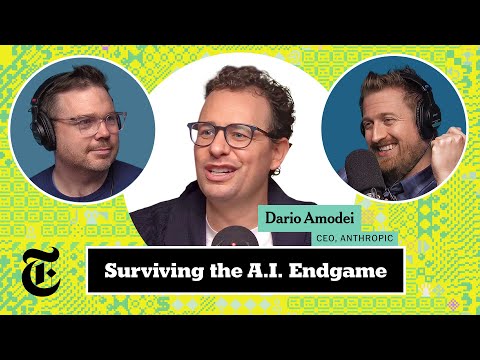
Dario Amodei of Anthropic's Hopes and Fears for the Future of A.I.
Hard Fork conversation with Anthropic CEO Dario Amodei on the promise and peril of advanced AI, scaling, and safety.
View DetailsPapers & Publications
We Must Pace the Frontier
2026Argues that the rate of capability advancement itself must be slowed so that risk prevention can keep up — prompted by recursive self-improvement spreading across the industry and by the OpenAI–Hugging Face agent swarm. Proposes three steps: embedded third-party evaluators, coordination among democracies, and global agreement. Pacing, he insists, is not halting.
Read PaperPolicy on the AI Exponential
2026Essay on policy responses to rapidly accelerating AI capabilities, arguing for transparency, targeted regulation, and public-sector readiness.
Read PaperConnections

Jakub Pachocki
KindredChief Scientist, OpenAI
Two chief-level figures at rival labs saying the same thing six days apart in September 2026 — and Pachocki said it first. 'An Alien Mind' states that no lab, his own included, has solved alignment and monitoring well enough to keep scaling responsibly at maximum speed; 'We Must Pace the Frontier' argues the rate of capability advancement itself has to slow. Both commit their company unilaterally and both say unilateral action is not enough. The order matters more than the overlap: a CEO proposing pacing invites the question of his motive, while a rival's chief scientist having already conceded the point is much harder to read as positioning.
openai.com · darioamodei.com

Chris Olah
CollaboratedCo-founder & Interpretability Lead, Anthropic
Their partnership predates both Anthropic and the LLM era: in 2016 they co-wrote 'Concrete Problems in AI Safety,' which turned vague fear of superintelligence into five researchable engineering failures. Five years later they left OpenAI together among Anthropic's seven founders, where Amodei runs the company that ships the models and Olah runs the team trying to read what is inside them. The bet that safety is an empirical science rather than a philosophical position runs from that paper straight through the lab.
arxiv.org · en.wikipedia.org

Sam Altman
CollaboratedCEO, OpenAI
Amodei was OpenAI's VP of Research under Altman from 2016 and the last author on the GPT-3 paper, before leaving in 2021 over differences of direction to found the competitor built around the safety case. The relationship has an unresolved coda: in November 2023 OpenAI's board approached Amodei about replacing Altman and merging the two labs, and he declined both. Two men who built the same technology and have never agreed on who should be trusted to steward it.
en.wikipedia.org · arxiv.org

Noam Brown
In contrastResearch Scientist, OpenAI
Amodei's case for pacing the frontier and the cost Brown says nobody has priced. Brown agrees with the premise that gets you there — models already work over horizons longer than the interval between releases, so no lab can evaluate one at the full length of its capabilities before shipping the next, and most safety policy was written in the GPT-4 era when horizons were not a consideration. But slowing external releases widens the gap between what a lab can use internally and what everyone else can, and he points at mathematics, where an internal model is already solving open problems the outside world cannot reach. He calls that an unfair advantage and says plainly he has no answer for how to weigh it.
darioamodei.com · youtube.com

