
Hans-Georg Gadamer
Philosopher & Founder of Hermeneutics
About
Hans-Georg Gadamer (1900–2002) was a German philosopher and the founder of philosophical hermeneutics—the study of how understanding and interpretation are possible at all. A student of Martin Heidegger at Marburg, he spent most of his career at Heidelberg and published his magnum opus 'Truth and Method' in 1960. He argued that understanding is never presuppositionless: we always interpret from within a horizon of tradition and 'prejudice' (pre-judgment), and genuine understanding happens as a 'fusion of horizons' in dialogue between interpreter and text. His claim that 'Being that can be understood is language' places interpretation at the center of human existence—and frames a sharp question for AI: whether a system that processes language statistically participates in the dialogical, tradition-bound understanding Gadamer describes, or only simulates its surface.
Key Contributions
- Founded philosophical hermeneutics with 'Truth and Method' (1960), reframing interpretation as the basic mode of human understanding
- Developed the 'fusion of horizons,' describing understanding as a meeting between the interpreter's world and the text's
- Rehabilitated 'prejudice' and tradition as the enabling conditions of understanding rather than mere obstacles to objectivity
- Argued that understanding is dialogical—a question-and-answer conversation—rather than a method for extracting fixed meaning
- Claimed that 'Being that can be understood is language,' placing language at the heart of interpretation and experience
- Debated Habermas over tradition versus critique and Derrida over the limits of dialogue, shaping late-twentieth-century continental thought
Questions they sharpened View the streams
Books

Videos & Interviews
Gadamer: Hermeneutics and the Human Sciences
A lecture on Hans-Georg Gadamer's philosophical hermeneutics—how understanding works in the human sciences through interpretation, tradition, and the fusion of horizons, rather than the detached method of the natural sciences.
View Details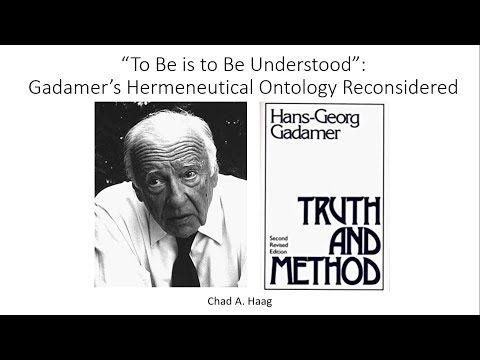
To Be is To Be Understood: Hans-Georg Gadamer, Truth and Method Book Overview
An overview of Hans-Georg Gadamer's 'Truth and Method,' unpacking his thesis that "being that can be understood is language"—that understanding is not a method we apply but the mode in which we exist, unfolding through language, tradition, and dialogue.
View Details
Truth and Method | Gadamer
A close reading of Gadamer's 'Truth and Method,' tracing his account of the hermeneutic circle, the rehabilitation of prejudice and tradition, and the fusion of horizons through which interpreter and text arrive at understanding.
View Details
