
Howard Gardner
Developmental Psychologist, Harvard Graduate School of Education
About
Howard Gardner (b. 1943) is an American developmental psychologist best known for the theory of multiple intelligences, introduced in his 1983 book Frames of Mind. Against the idea of a single general intelligence measured by IQ, he argued that the mind comprises several relatively independent capacities — linguistic, logical-mathematical, musical, spatial, bodily-kinesthetic, interpersonal, intrapersonal, and naturalistic. The theory reshaped debates in education even as psychometricians contested its empirical basis. He is the Hobbs Research Professor of Cognition and Education at Harvard, where he has taught since the 1980s and retired from classroom teaching in 2019.
Key Contributions
- Proposed the theory of multiple intelligences in Frames of Mind (1983)
- Challenged the primacy of a single 'g' factor and IQ-based views of the mind
- Extended the framework to education, assessment, and the idea of intelligence as plural
- Co-directed Harvard Project Zero, studying learning and cognition in the arts and beyond
- Authored later works on ethics and 'good work,' including Five Minds for the Future
Questions they sharpened View the streams
Books

Videos & Interviews

Howard Gardner on Multiple Intelligences
Edutopia's interview with Gardner on multiple intelligences and new forms of assessment.
View Details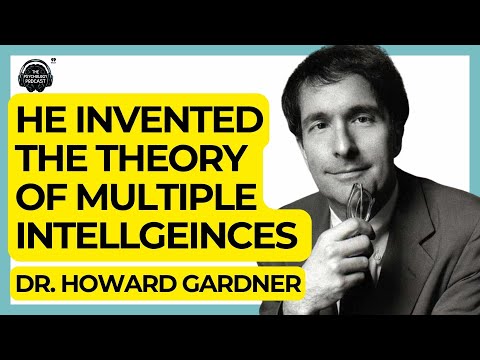
Multiple Intelligences w/ Dr. Howard Gardner | The Psychology Podcast
A long-form conversation on the origins and reception of the theory of multiple intelligences.
View Details
