
Jaron Lanier
Computer Scientist, VR Pioneer & Tech Philosopher
About
Jaron Lanier is a computer scientist, author, and pioneer who coined the term 'virtual reality' and founded the first VR company in the 1980s. Currently at Microsoft Research, he is known for his philosophical critiques of AI and social media. He argues that AI should be reconceived as 'collective human collaboration' rather than an autonomous intelligence, advocating for 'data dignity' where individuals control and are compensated for their contributions to AI systems.
Key Contributions
- Popularized the term 'virtual reality' and founded VPL Research, one of the first companies to sell VR goggles and gloves
- Built a career spanning computer science, music, interface design, and Microsoft Research rather than a single technical niche
- Wrote 'You Are Not a Gadget,' an early critique of web platforms that flatten people into data and engagement metrics
- Developed the data-dignity argument in 'Who Owns the Future?', asking who should benefit when networks learn from human work
- Argues that AI should be understood as collective human work, not as an alien autonomous mind
- His humanist critique is influential, though skeptics question whether data-payment schemes can work at internet or model scale
Questions they sharpened View the streams
Books

Videos & Interviews
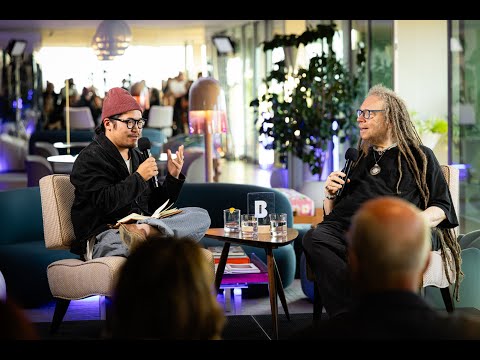
Daniel Kwan & Jaron Lanier: Can Human Storytelling Survive the Algorithm?
Berggruen Institute Studio B conversation on AI's Hollywood takeover and why the industry must unite to set the terms of adoption
View Details
Father of VR: The best AI future nobody is talking about | Jaron Lanier
Jaron Lanier discusses virtual reality, human-centered AI, and alternative futures for artificial intelligence.
View Details
Jaron Lanier Fixes the Internet | NYT Opinion
New York Times Opinion video on reconceiving AI and data dignity
View Details
Jaron Lanier: Virtual Reality, Social Media & the Future of Humans and AI
Lex Fridman Podcast #218 - Deep discussion on VR, social media, consciousness, and human-centric AI
View Details
Why AI Should Pay Us for Being Human | The Futurology Podcast
Jaron Lanier discusses why people should be compensated for the human creativity, culture, and data that make AI systems valuable.
View DetailsConnections

Alan Turing
In contrastMathematician & Computer Science Pioneer
Lanier's quarrel is not with the man but with what the imitation game did to the field's standard of evidence. Turing, unable to build a personhood meter and unsure what intelligence was, settled for the one thing that could be observed: whether a person is fooled. Lanier's charge is that the test never became antiquated at all — 'the Turing test is still the paradigm for AI products, for AI culture, for everything' — and that a discipline built to stop people fooling themselves reorganized around fooling them: 'science became theater, science became stage magic.' He traces the truth crisis to that inversion.
youtube.com

Audrey Tang
CollaboratedCyber Ambassador-at-large, Taiwan
In 2024 Lanier, Allison Stanger, and Tang co-wrote a proposal to sunset Section 230's liability shield for algorithmic amplification while protecting citizens' direct speech — 'algorithmic amplification is a product, not a public service.' Lanier's blurb for Plurality calls it 'a peek at the humanistic high tech future we suspected was possible,' and elsewhere he names Tang and Glen Weyl as the idea's finest exponents while adding that they do not all agree and should not. The pairing is data dignity meeting plurality: a man who wants people paid for what the models learned from them, beside a woman who put ten years of her own meetings in the public domain so the models could learn her outright.
ash.harvard.edu · dl.acm.org · plurality.net · youtube.com

Daniel Kwan
In conversationFilmmaker & Director
A Berggruen Institute evening, on this site, closing a science-fiction writing retreat. Kwan opened by collapsing the distance in the title himself: what is a story but a version of an algorithm, 'compressing information into a thing that allows the human brain to understand it,' a rulebook for moving through life, so that an Aesop fable is already behavioral engineering — the change now being one of scale and of kind. Lanier, who has spent two decades arguing that recommendation systems are behavior modification with a business model, had the harder job of saying what the difference is. A filmmaker and a computer scientist meeting on the suspicion that narrative and algorithm were never separate crafts.
youtube.com

