
Jensen Huang
Founder, President & CEO, NVIDIA
About
Jensen Huang (Jen-Hsun Huang) is the founder, president, and CEO of NVIDIA, the company whose 1993 founding from a Denny's restaurant led to the invention of the GPU in 1999 — a breakthrough that transformed gaming, scientific computing, and ultimately enabled the deep learning revolution. Born in Taiwan in 1963, he moved to the United States as a child, earned his BSEE from Oregon State University and MSEE from Stanford. Under his leadership, NVIDIA became the world's most valuable company, powering the infrastructure behind modern AI. He is widely regarded as the architect of the GPU computing era.
Key Contributions
- Co-founded NVIDIA in 1993 and bet on accelerated graphics before GPUs became the engine of modern AI
- Led NVIDIA from near-failure into GPU leadership, first through graphics and later high-performance computing
- Backed CUDA and general-purpose GPU computing, turning gaming hardware into a platform for deep learning and scientific workloads
- Built NVIDIA's data-center stack — GPUs, networking, CUDA libraries, and DGX systems — into the default infrastructure for frontier AI labs
- Led NVIDIA through the generative-AI boom to become one of the world's most valuable companies
- Also became a symbol of AI's hardware bottleneck: supply constraints, export controls, and dependence on a single vendor now shape the field
Moments Timeline View all moments
Videos & Interviews
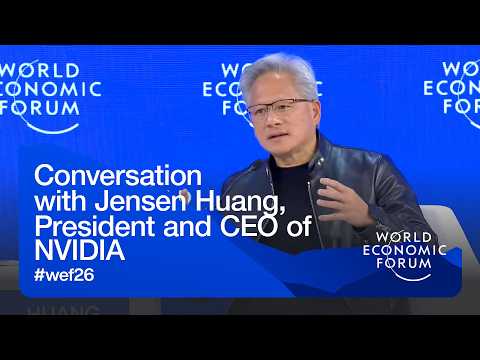
Conversation with Jensen Huang, President and CEO of NVIDIA | WEF Annual Meeting 2026
Jensen Huang discusses AI, computing, and NVIDIA's vision at the World Economic Forum in Davos 2026
View Details
Jensen Huang: The Doomer Hoax, Superintelligence is Here, and The Future of AI (ft. President Trump)
Two days after Dario Amodei argued the frontier should be paced, Huang is asked on stage at the All-In Summit what to make of the number going around: a greater-than-10% chance AI kills everyone within the decade. His answer is that the figure is made up, and that hearing it from researchers inside a lab is what makes it irresponsible. The case he builds is a track record: radiology gone in five years, ninety percent of code written by AI within six to twelve months, half of entry-level jobs wiped out, GPT-2 and Llama 3 too dangerous to release. All wrong, and nobody accountable for having been wrong.
View Details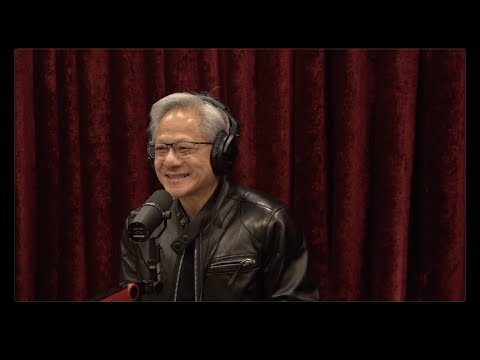
Joe Rogan Experience #2422 - Jensen Huang
Wide-ranging conversation on the AI revolution, NVIDIA's origins, fear of failure, and the future of computing
View Details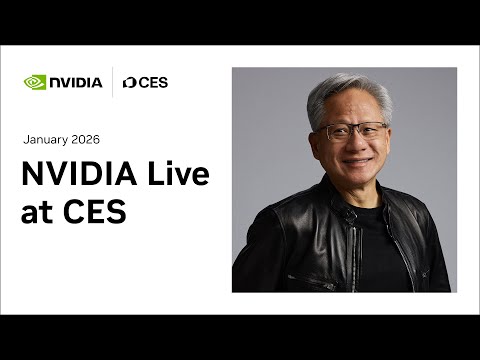
NVIDIA CES 2026 Keynote with CEO Jensen Huang
NVIDIA's CES 2026 keynote covering next-gen chips, robotics, AI infrastructure, and the future of computing
View DetailsConnections

Ilya Sutskever
In conversationCo-founder, Safe Superintelligence Inc.
In 2012 Sutskever and Krizhevsky trained AlexNet on two consumer NVIDIA gaming cards, and Huang has called the result the big bang of AI — the moment a graphics company discovered what its chips were actually for. Eleven years later they sat down together at GTC, the day after GPT-4 launched, and Huang put the arithmetic plainly: over the decade they had known each other, the models Sutskever trained had grown roughly a million times. The exchange is the clearest record of how completely the supply of compute and the ambition of research have come to define one another.
blogs.nvidia.com · en.wikipedia.org

Jeff Dean
In contrastCo-founder, Discovery Loop
An opposition of strategies rather than of persons. Huang's answer to AI's compute problem was to make one company's chips and software the substrate everyone else rents; Dean's Google built the TPU so that it would not have to rent. Between them sits the field's quiet constitutional question — whether the machinery of intelligence should be a market with one dominant supplier or something each large actor makes for itself — and every frontier lab now sits somewhere on that line.
youtube.com

Chris Lattner
In contrastCo-founder & CEO, Modular
Modular exists because of what NVIDIA built. CUDA turned a graphics company into the substrate of AI by making its own hardware the only place the software was pleasant to write; Lattner's answer — first MLIR, then Mojo — is to attack that lock-in at the compiler layer, so performance need not be tied to one vendor's ecosystem. Whether AI compute stays a moat or becomes a commodity is being decided in this unglamorous stratum, not at model launches.

Nathan Lambert
KindredAI Researcher & Author, Interconnects
Both argue that open weights serve American interests, and the reasons could hardly be more different. Huang published his 2026 letter as the vendor whose business improves when models become a commodity and compute becomes the scarce thing; Lambert argues from the researcher's side, where a model you cannot inspect, retrain, or reproduce is not really an object of study. The pairing is worth holding because it shows openness is not one position but a place where a commercial interest and a scientific one happen to point the same way.

