
John von Neumann
Mathematician & Computer Architecture Pioneer
About
John von Neumann (1903–1957) was a Hungarian-American mathematician whose contributions span mathematics, physics, economics, and computer science. He designed the von Neumann architecture—the stored-program concept that remains the basis for virtually all modern computers. He co-founded game theory, contributed to quantum mechanics, and worked on the Manhattan Project. His late work on self-replicating automata and the brain as a computing machine anticipated key ideas in AI and artificial life.
Key Contributions
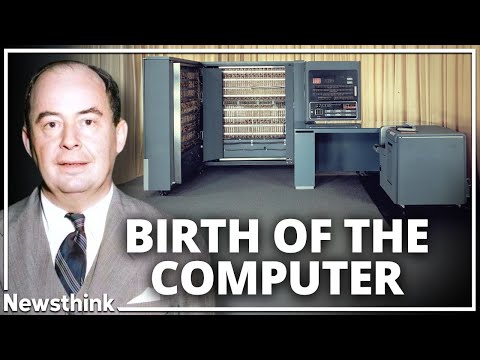
- Articulated the stored-program computer architecture associated with EDVAC, still the template for most conventional computers
- Co-founded game theory with 'Theory of Games and Economic Behavior,' shaping economics, strategy, and multi-agent reasoning
- Helped put quantum mechanics on a rigorous mathematical footing through Hilbert-space formalism and operator methods
- Advanced numerical analysis and early high-speed scientific computing, including work that fed into weather prediction and simulation
- Worked on the Manhattan Project and later nuclear strategy, making his legacy technically vast and morally uneasy
- Developed cellular automata and self-reproducing automata, anticipating artificial life and parts of theoretical AI
- Influenced economics, physics, computing, and military policy enough that his name became attached to several fields, not just one architecture
Questions they sharpened View the streams
Videos & Interviews
Papers & Publications
Connections

Alan Turing
Influenced byMathematician & Computer Science Pioneer
Von Neumann was at Princeton while Turing was, was intrigued enough by the universal machine to offer him a postdoctoral post, and later made the 1936 paper required reading for his own computer project at the Institute for Advanced Study. Stanley Frankel recorded von Neumann calling himself only 'the midwife' and insisting that 'the fundamental conception is owing to Turing.' The machine on your desk is still called a von Neumann architecture — a name he would have treated as a misattribution.
plato.stanford.edu · plato.stanford.edu · en.wikipedia.org

Claude Shannon
KindredMathematician & Father of Information Theory
Von Neumann's chapter in the volume Shannon co-edited asked how reliable organisms can be synthesized from unreliable components — which reads as the machine-shaped form of the question Shannon had already answered for messages, showing that redundancy can carry meaning intact through a noisy channel. Taken together they mark the moment engineering stopped treating error as failure and began treating it as a quantity to be budgeted. Modern machine learning lives entirely inside that shift.
Automata Studies, Annals of Mathematics Studies 34 (1956) — von Neumann, 'Probabilistic Logics and the Synthesis of Reliable Organisms from Unreliable Components', pp. 43–98

