
Judea Pearl
Chancellor's Professor of Computer Science, UCLA
About
Judea Pearl is an Israeli-American computer scientist and philosopher, Chancellor's Professor of Computer Science and Statistics at UCLA, where he directs the Cognitive Systems Laboratory. He received the 2011 ACM Turing Award for fundamental contributions to artificial intelligence through the development of a calculus for probabilistic and causal reasoning. His work on Bayesian networks revolutionized how machines handle uncertainty, and his theory of causal inference has transformed fields from epidemiology to social science. He is the author of "The Book of Why: The New Science of Cause and Effect" (2018), which brought causal reasoning to a broad audience.
Key Contributions
- Developed Bayesian networks, giving AI a practical graphical language for reasoning under uncertainty
- Created do-calculus and structural causal models, formalizing when data can support causal claims rather than mere correlations
- Turned causal inference into shared infrastructure for statistics, epidemiology, social science, and AI rather than a narrow AI subfield
- Received the 2011 Turing Award for foundational work in probabilistic and causal reasoning
- Popularized causal inference through 'Causality' and 'The Book of Why,' including the ladder of causation
- His critique of curve-fitting AI remains sharp, though some ML researchers see causal formalism as harder to scale than Pearl's rhetoric suggests
Videos & Interviews
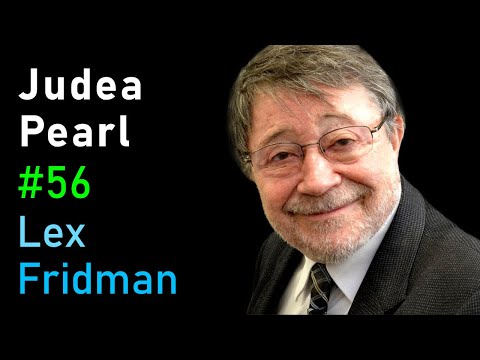
Judea Pearl: Causal Reasoning, Counterfactuals, and the Path to AGI | Lex Fridman Podcast #56
Wide-ranging conversation on Bayesian networks, counterfactual reasoning, and what machines need to achieve true intelligence
View Details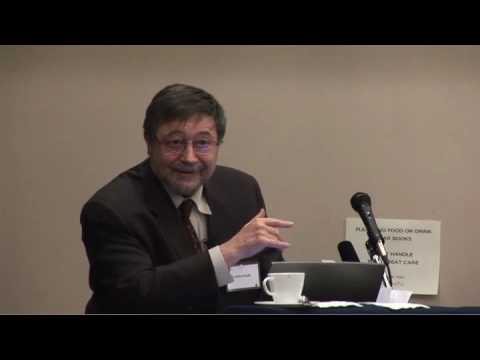
The New Science of Cause and Effect
Pearl's talk on how causal reasoning transforms our understanding of AI and science
View DetailsConnections

Geoffrey Hinton
In contrastAI Pioneer & Researcher
Pearl is the man who taught AI to reason with probability, and then spent his later career arguing that probability is not enough: 'All the impressive achievements of deep learning amount to just curve fitting,' stuck on the bottom rung of association, unable to represent an intervention or a counterfactual. Hinton's position is that a model compressing the world well enough to predict it has thereby come to understand it. What the reader has to decide is whether Pearl's ladder is a hierarchy of formalisms or a hierarchy of minds.
quantamagazine.org

Yoshua Bengio
KindredAI Pioneer & Safety Researcher
An interpretive pairing that tracks how a critique gets absorbed. Pearl spent decades arguing that association is the bottom rung and that machines need interventions and counterfactuals to climb; Bengio, from inside deep learning, turned toward causal representation learning and System 2 reasoning on much the same grounds. Wired recorded Pearl saying he was impressed by Bengio's ideas though he had not studied them closely — the sound of an argument crossing a field boundary and arriving slightly translated.
aiws.net · arxiv.org

Gary Marcus
In conversationCognitive Scientist, AI Critic & Author
They shared the programme at Montréal.AI's AI Debate 2 in December 2020, Marcus moderating the panels and Pearl arguing that the next generation of systems needs added knowledge rather than more data. Both had arrived at causality as the missing piece by different roads — Pearl through decades of formal work on interventions and counterfactuals, Marcus through cataloguing the failure modes of deep nets. The overlap is real but partial: Pearl's calculus asks for something far more specific than the hybrid architectures Marcus proposes.
syncedreview.com

