
About
Maggie Appleton is a designer, illustrator and engineer who works at the edge where interfaces meet language models, currently as a Staff Research Engineer at GitHub Next, building prototypes that explore how software engineers might collaborate with AI. She studied cultural anthropology, which she still uses as a lens on design — how people decide something is trustworthy, which way time flows. She spent five years illustrating programming concepts at Egghead, led design at HASH, and was the founding product designer at Elicit, which uses language models to pull reliable data out of research papers. She writes and draws in public at maggieappleton.com, where her essays on digital gardens, end-user programming and language model interfaces have travelled far beyond the design world.
Key Contributions
- A Brief History & Ethos of the Digital Garden (2020), the essay that gave the digital-garden movement its history and vocabulary
- Coined "barefoot developers": people technical enough to push Notion and spreadsheets to their limits but not programmers, whom language models could equip to build home-cooked software for their own communities
- Founding product designer at Elicit (2022–2024), designing interfaces for using language models to speed up scientific literature review
- Illustrated essays that explain programming and AI visually, from five years as illustrator and art director at Egghead
- At GitHub Next, prototypes how teams and many background agents might work together without the agents becoming overwhelming
Videos & Interviews
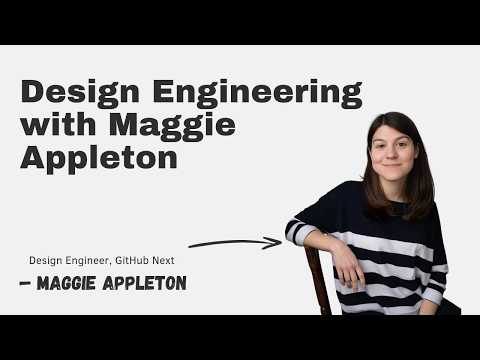
Design Engineering with Maggie Appleton
A cultural anthropologist turned illustrator turned design engineer, now prototyping at GitHub Next, talks with Gergely Orosz about what agents changed in her work and what they did not. Building is faster: she can hand an agent a Figma file and let it loop overnight until the screenshots match. But she still starts with pen and paper, because the agent cannot see what she sees, and she still ends up adjusting padding and transitions by hand, because the design rules she writes down never quite get applied. Her team's open question is what a hundred background agents would look like if they were not annoying. She closes on anthropology as a pair of glasses for engineers: how a thing earns trust, which way time flows, and when someone reaches for your tool are all cultural.
View Details
Home-cooked Software and Barefoot Programmers: Maggie Appleton (Local-First Conf)
Industrial software can only serve the biggest problems of the most people; everything else is the long tail, and no one in Mountain View will build for it. Appleton's bet is that language models move that line. Not for end users, who mostly don't want to program, and not for professional developers, who already have it good, but for the people in between — the teacher with the elaborate Notion setup, the spreadsheet wonk — whom she calls barefoot developers, after China's barefoot doctors. Embedded in their communities, they could build home-cooked apps for local problems, if something glued the models' disconnected Lego pieces into working software. Whoever builds that glue decides the defaults, and she wants local-first to be one of them.
View DetailsConnections

Bret Victor
Influenced byInterface Designer & Computing Visionary
Appleton's writing on programming interfaces starts from Victor's. Her essay on making programming visual, spatial and learnable takes its name from his 'Learnable Programming' and its premise from his line that people understand what they can see; 'Programming Portals' says the case for dynamic, interactive media has been well trodden by him. What she adds is the practitioner's question he mostly left open: how a small, scoped piece of that vision fits inside the apps people already use.
maggieappleton.com · maggieappleton.com · maggieappleton.com

Andy Clark
Influenced byPhilosopher & Cognitive Scientist
When Appleton asks what a 'second brain' really is, she answers with Clark. Her essay 'How to Become a Neo-Cartesian Cyborg' takes from Natural-Born Cyborgs the claim that what sets humans apart is how fully we fold tools and cultural practices into ourselves, and her talk on tools for thought sets his extended mind beside Engelbart and Kay: we think not inside the skull but across brain, body and world. It is why she treats note-taking apps as cultural practices rather than computational objects.
maggieappleton.com · maggieappleton.com

Alan Kay
In contrastComputer Scientist & Personal Computing Pioneer
A pairing within one tradition rather than a quarrel. Kay's Dynabook imagined a medium everyone would author in, the founding dream of end-user programming; Appleton, who calls herself a proponent of that dream in theory, told the Local-First conference that most people do not want to program and we should stop asking nurses and teachers to learn to code. Her 'barefoot developers' amend the dream rather than abandon it: not everyone, but the technically curious few already embedded in a community, with language models carrying what Kay hoped a better medium would.
youtube.com · maggieappleton.com

John Maeda
KindredCVP Engineering, GitHub Design & Microsoft CoreAI Design
A pairing about software made for one occasion. Maeda builds a new presentation system for every talk he gives, the latest in a weekend with speech-to-text and live interpretation, and shrugs that 'we all can do this now'; Appleton's 'home-cooked software' describes apps made like meals, for the people you know, by barefoot developers that language models might finally equip. He is the professional for whom the cost of a bespoke tool fell to nearly nothing; she asks who else that fall could reach.

