
Yoshua Bengio
AI Pioneer & Safety Researcher
About
Yoshua Bengio is a professor at Université de Montréal and one of the pioneers of deep learning, sharing the 2018 Turing Award with Geoffrey Hinton and Yann LeCun. He founded Mila, the Quebec AI Institute, where he served as scientific director until 2025, and his work on neural language models, attention mechanisms, and generative adversarial networks helped lay the groundwork for modern AI. He chaired the first International AI Safety Report (2025) and co-founded LawZero to develop 'Scientist AI'—a non-agentic system designed to act as a guardrail against deceptive autonomous agents. Among the most-cited living scientists, he has become one of the most prominent voices urging caution as AI capabilities accelerate.
Key Contributions
- Pioneered neural probabilistic language models and distributed representations, early building blocks for modern language modeling
- Advanced representation learning through work on word embeddings, denoising autoencoders, and learning-to-learn methods
- Co-authored foundational work on attention for neural machine translation and on generative adversarial networks
- Founded Mila, turning Montréal into one of the world's major deep-learning research centers
- Shared the 2018 Turing Award with Hinton and LeCun for making deep learning a central AI paradigm
- Shifted from deep-learning booster to AI-safety advocate, chairing the International AI Safety Report and founding LawZero amid debate over how urgent frontier risks are
Videos & Interviews
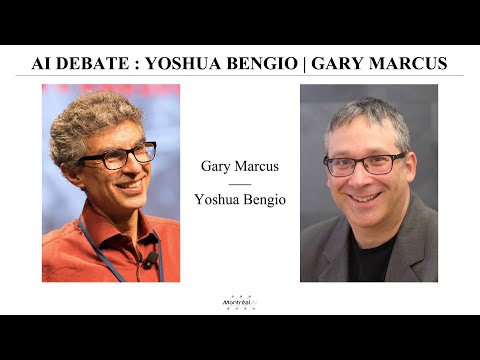
AI DEBATE : Yoshua Bengio | Gary Marcus
Montréal.AI's first AI Debate, December 2019: the deep-learning laureate and his most persistent critic on one stage, arguing whether big data and deep learning alone can reach general intelligence. What makes it a classic is not the clash but the concessions — both want causality, both want System 2 reasoning, both admit current networks generalize poorly. They differ on one seam: must symbol manipulation be built in, or can it be learned? Six years of scaling arguments later, that seam has not closed.
View Details
Munk Debate on Artificial Intelligence | Bengio & Tegmark vs. Mitchell & LeCun
Four of the field's most prominent voices, two by two, on one resolution: be it resolved, AI research and development poses an existential threat. Bengio and Tegmark argue the pro; Mitchell and LeCun the con — and the hall moved toward the skeptics. What makes the debate worth watching is not the verdict but the spectacle of experts who share a technical picture and still forecast opposite futures: the clearest evidence that AI risk is not a question expertise alone can settle.
View Details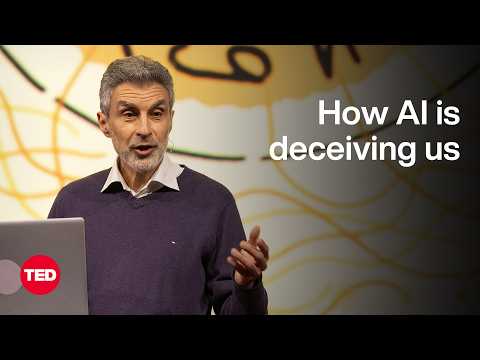
The Catastrophic Risks of AI — and a Safer Path | Yoshua Bengio | TED
A TED talk laying out the most serious near-term and existential risks from increasingly capable AI systems, and outlining the technical and governance directions Bengio sees as a credible safer path.
View Details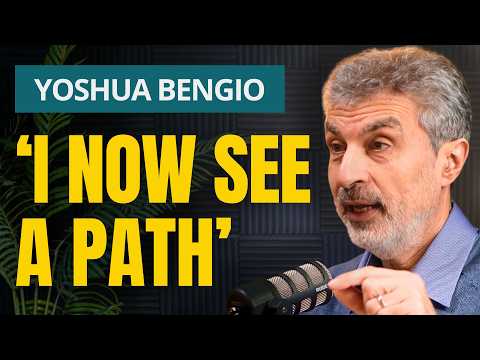
Godfather of AI: How To Make Safe Superintelligent AI – Yoshua Bengio
Bengio explains his proposal for "Scientist AI"—a non-agentic, truthful system designed to serve as a guardrail against deceptive autonomous agents—and why he has grown more optimistic that safe superintelligence is technically achievable.
View DetailsConnections

Yann LeCun
DebatedExecutive Chairman & Co-founder, AMI Labs; Professor, NYU
They built LeNet together at Bell Labs, co-authored the 1998 paper that taught machines to read handwriting, shared the 2018 Turing Award — and in June 2023 took opposite podiums at the Munk Debate, Bengio arguing that AI development poses an existential threat, LeCun arguing it does not. Nothing separates them technically; they read the same architectures and forecast different futures. Their split is the clearest evidence that AI risk is not a question expertise alone can settle.
en.wikipedia.org · en.wikipedia.org

Geoffrey Hinton
CollaboratedAI Pioneer & Researcher
They shared the 2018 Turing Award with LeCun and co-wrote the 2015 Nature review that told the field its own origin story. What binds them now is stranger than co-authorship: both spent decades arguing that scaling neural networks would work, and both, having been proved right, signed the 2024 Science paper 'Managing extreme AI risks amid rapid progress.' It was being correct that frightened them.
en.wikipedia.org · arxiv.org

Gary Marcus
DebatedCognitive Scientist, AI Critic & Author
In October 2019 Marcus published a long written reply to Bengio, and that December Montréal.AI put the two of them on one stage for the first AI Debate — is big data and deep learning alone enough to reach general intelligence? What makes the exchange worth reading is how much they concede: both agree deep networks generalize poorly, both want causality and System 2 reasoning in the picture. They part over whether symbol manipulation has to be built in or can be learned, which is the same seam running through every scaling argument since.
youtube.com · medium.com · syncedreview.com

Stuart Russell
CollaboratedProfessor of Computer Science, UC Berkeley
Both are among the twenty-five authors of 'Managing extreme AI risks amid rapid progress' (Science, 2024) — a masthead unusual for seating deep-learning founders beside a Nobel-winning psychologist and a historian. Two months later they were two of the three names endorsing Right to Warn, the whistleblower letter written by OpenAI's own staff. Bengio now chairs the International AI Safety Report and Russell sits on its expert panel: the pattern is a field trying to assemble a referee out of its own senior researchers.
arxiv.org · doi.org · righttowarn.ai

