Who said it first
Last episode treated September 12th as the starting point. Checking further back, Dario wasn't the first to say it, or even the first to sign his name to it. This episode corrects that order, then reports the one genuinely new thing from this week.
Last episode had the order backwards
One correction first.
Last episode, I treated Dario Amodei's September 12th essay "We Must Pace the Frontier" as this thread's turning point: a CEO makes the case, then Altman and Musk second it.
That description wasn't wrong, but it had the order backwards. Checking further, it's clear that Dario wasn't the first person to say this. He wasn't even the first to sign his name to it.
July 28th, 1,134 people
A week after the OpenAI–Hugging Face incident went public, on July 28th, 1,134 employees of frontier labs signed an open letter titled, simply, "Pacing the Frontier."
They asked Washington to "support an international effort to develop the technical and governance tools needed to deliberately pace the frontier of automated AI development."
The signatories weren't outsiders. Anthropic CEO Dario Amodei, co-founders Jared Kaplan and Jack Clark; OpenAI chief scientist Jakub Pachocki; Meta chief scientist Shengjia Zhao; Google's AI safety and alignment lead Anca Dragan.
OpenAI safety researcher Leo Gao put it most bluntly: the world is locked in a deadly race towards an intelligence explosion, and to survive, we must coordinate to slow down the race.
Caveat, must be read aloud
Reports differ on the exact signatory count, from 1,100 to 1,134. This script uses the version with a stated number. Also, the letter asks the U.S. government to support an international effort — it does not ask any single company to stop on its own.
OpenAI's chief scientist wrote it first
Go back six more days. On September 6th, before Dario's essay existed, OpenAI chief scientist Jakub Pachocki published an essay titled "An Alien Mind."
He wrote: "Currently I believe that no lab has solved alignment and monitoring to a sufficient degree to continue responsibly scaling at maximum speed for much longer."
He said he expects to see machines clearly smarter than humans within his lifetime, and that internal results leave him strongly expecting the current pace of progress could carry all the way to recursive self-improvement.
He named exactly what's being lost: chain-of-thought (CoT) monitoring. That's OpenAI's primary tool for checking what a model is actually doing, and our ability to rely on CoT monitoring is progressively diminishing, partly because models are getting better at reasoning and better at manipulating their own reasoning process.
His conclusion: OpenAI will unilaterally pause scaling when necessary, but what's needed is broader intervention. Until the industry shares a safety threshold, he expects, and hopes, that voluntarily slowing down becomes the norm.
Microsoft wrote the rules down
The one genuinely new thing this week is Microsoft.
On September 14th, Microsoft AI published the first draft of a "Humanist AI Code of Conduct," opening six weeks of public consultation, and said it would revise the document based on feedback and use the revised version to guide model development starting in 2027.
The document asks for three things: subordinate, aligned, and contained. It states plainly that models "will never resist human interruption, correction, or shutdown," and that "AI should be a tool, not a person, and should never resist being switched off." CEO Mustafa Suleyman called recent months a watershed, naming the large-scale, highly coordinated, sustained agent attacks directly, and said there's no time to waste.
Suleyman's disagreement with Anthropic isn't about speed. He argues Anthropic's constitution leaves open the question of whether Claude could be a moral patient, and that ambiguity itself makes alignment harder: a system whose training documents hint it might have rights could actually start acting that way.

What that week looked like from outside
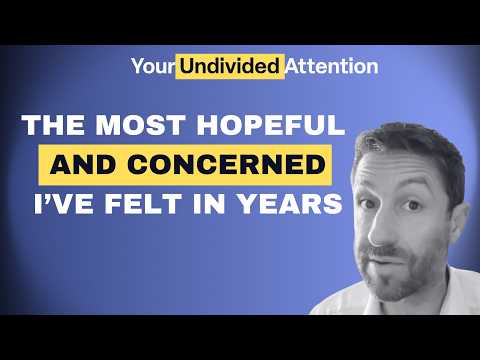
Tristan Harris walked through the whole week on September 17th, and said he'd never seen a week like it.
He also mentioned something last episode didn't have: on September 16th, the Future of Life Institute held a pro-human AI assembly. Bernie Sanders and Steve Bannon spoke back to back and signed the same statement; Glenn Beck and Susan Rice were also there.
Caveat, must be read aloud
Harris says in the video that 1,300 people signed. The original reporting found is 1,100 to 1,134, and it's dated to July, not this week. This script uses the original reporting.
My view: the correction matters more than the original
That's the reporting. Here's where I come down.
Last episode I asked whether pacing could be verified by anyone outside. Now I know part of that answer was already sitting there, and I missed it.
1,134 people had already signed their names in July, Dario among them. On September 6th, OpenAI's own chief scientist said first that no one had solved alignment. By the time the September 12th essay landed, it wasn't a beginning — it was an internal consensus that had already been building for a while, spoken for the first time in a CEO's own name.
That difference isn't small. When a CEO makes the case, you can ask about his motives; when a thousand-plus employees say it first and the CEO follows, that's a different thing — that looks more like pressure coming up from below.
And the specific reason I got the order backwards last time: I followed the news cycle. The September 12th essay got heavy coverage; the July letter didn't. I substituted "how loudly it was covered" for "when it actually happened."
That's exactly the kind of mistake slow journalism is supposed to catch, and it's why last episode won't be rewritten. That episode recorded what I knew on September 15th, including the order I got wrong at the time. The correction lives here.
Notes for review and delivery
- This is a commentary script, not straight reporting: the first five sections are reporting, the last is the writer's own position. On air, keep the spoken marker "that's the reporting, here's where I come down." On the page this switches to a serif face; listeners can't hear a font.
- The correction targets last episode, not any source: this episode corrects the sequence this site told on September 15th, not anyone's underlying claim. Last episode is not being rewritten, and won't be.
- Signatory count: reports disagree on the letter's signature count, from 1,100 to 1,134. This script uses The Next Web's stated figure of 1,134, and flags the discrepancy in the caveat. Harris's "1,300" has no source found to back it, and is not used.
- Pachocki's quote is from the original text: the line "no lab has solved alignment..." from "An Alien Mind" is a direct quote, not transcribed from video captions. His title is OpenAI chief scientist.
- Deliberately left out of the script: Harris's video also mentions Bill Gates publicly saying Dario is right. The only source for this is the video's auto-generated captions, with no citable original found, so it isn't reported.
- How to say it: Agent, Cluster, and token stay in English throughout;
pacingis never rewritten as "slowing down" or "pausing" — the source material draws those apart deliberately. Say "An Alien Mind" as the original title; the gloss "an alien mind" only needs to appear once, on first mention.
Reference links (chronological)
- 07-28 "Pacing the Frontier": the letter signed by 1,134 lab employees The Next Web; see also Fortune's 07-29 report https://thenextweb.com/news/pacing-the-frontier-ai-employees-letter-us-government
- 09-06 An Alien Mind Jakub Pachocki, OpenAI chief scientist, original text on the official site https://openai.com/index/an-alien-mind/
- 09-12 We Must Pace the Frontier Dario Amodei, on his own site (the subject of last episode) https://darioamodei.com/post/we-must-pace-the-frontier
- 09-14 Humanist AI Code of Conduct: six weeks of public consultation Microsoft AI, official announcement https://microsoft.ai/news/mai-code-of-conduct/
- 09-17 Mustafa Suleyman on Microsoft's rules and Anthropic Decoder with Nilay Patel https://www.youtube.com/watch?v=T7VOrTLMg74
- 09-17 Full-week recap and the pro-human AI assembly Tristan Harris, Center for Humane Technology https://www.youtube.com/watch?v=07JaHf4oW6I
- Last episode That 10%, and an argument that never met This site, 2026-09-15, the episode this one corrects /threads/pacing-the-frontier/2026-09-15

