
關於
Peter B. McCrory is the Chief Economist at Anthropic, where he leads the Economic Research team studying how AI will reshape labor markets and the broader economy. His team publishes the Anthropic Economic Index, a privacy-preserving measure of how people and businesses use Claude across tasks, occupations and countries, and releases its data so outside researchers can study AI's economic effects as they happen. Before Anthropic he was Head of Labor Research at LinkedIn's Economic Graph Research Institute, after working on an applied science team at LinkedIn that used machine learning for marketplace design and causal estimation. He earned his PhD in economics at UC Berkeley and then worked as an economist at JPMorgan, publishing research on US macroeconomic conditions. His public writing includes the essay "Why hasn't AI caused a rise in unemployment?", which argues that diffusion, not capability, sets the pace of AI's economic impact.
主要貢獻
- Leads Anthropic's Economic Research team and the Anthropic Economic Index
- Co-authored 'Estimating AI productivity gains from Claude conversations' (2025), estimating an ~80% task speedup and 1.8% annual US labor-productivity growth
- Co-authored the Economic Index report on uneven geographic and enterprise AI adoption (2025), open-sourcing its data
- Headed labor research at LinkedIn's Economic Graph, building a labor-market-tightness measure from job application data
- Co-authored 'Fiscal Multipliers in the COVID-19 Recession' with Auerbach, Gorodnichenko and Murphy (NBER, 2021)
影片與訪談
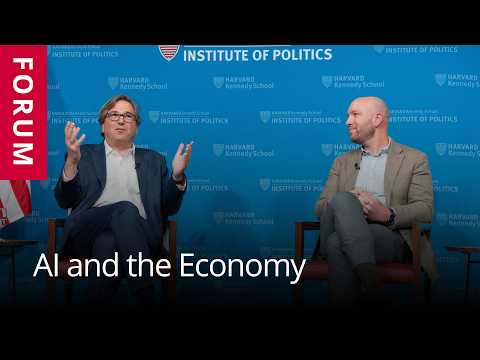
Anthropic’s Chief Economist Breaks Down AI and the Future of the Economy
A JFK Jr. Forum conversation at Harvard's Institute of Politics, moderated by former Council of Economic Advisers chair Jason Furman, on why AI's rapidly rising capabilities have yet to show up in unemployment or productivity data. McCrory explains how his team builds the Anthropic Economic Index from privacy-preserving Claude usage data, why diffusion lags capability, and the open questions of inequality and human-capital formation as students learn with, or lean on, AI.
View Details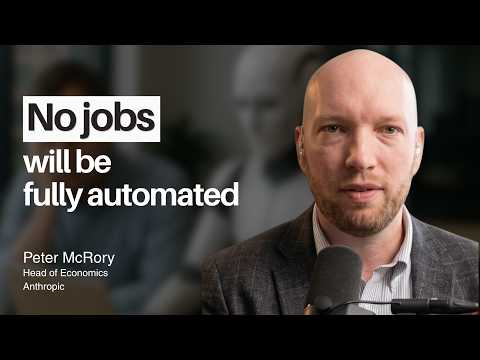
Anthropic Econ: Why AI Has Not Killed Full Employment | Peter McCrory
McCrory walks through his essay "Why hasn't AI increased unemployment?": linking Current Population Survey workers to Claude usage by occupation, he finds no material rise in unemployment even in the most automatable jobs, and reads AI so far as a skill-biased technology that automates some tasks while amplifying human expertise in the loop. He also names the research questions he calls most urgent — the economics of recursive self-improvement, how fast productivity gains arrive, and what happens to markets when AI agents transact on people's behalf.
View Details思想連結

Dario Amodei
思想對照執行長暨共同創辦人・Anthropic
2025 年 5 月,Amodei 警告 AI 可能抹去半數入門級白領工作,並在一到五年內把失業率推高到 10–20%。一年後,他自家公司的經濟學家把「當前人口調查」(Current Population Survey)中的勞工依職業對應到 Claude 的使用模式,發現失業率並未明顯上升——即使是 Claude 最能端到端自動化的那些工作也一樣。兩人的分歧與其說在機制,不如說在時間:McCrory 的文章只問「為什麼到目前為止還看不到影響」,並坦白地說,若能力的鋸齒狀邊界被磨平,答案可能就會改變。
youtube.com · fortune.com

Jack Clark
曾經對談共同創辦人暨政策主管・Anthropic
Anthropic 共同創辦人暨公共利益負責人 Clark,與首席經濟學家 McCrory,在 2026 年 6 月一同上了 Bloomberg 的 Odd Lots,談公司如何權衡安全與經濟風險,包括它為「遞迴式自我改進」所做的準備。這場對談讓這間實驗室的兩種公共語調並排出現:Clark 談能力可能走向何方,McCrory 談數據顯示它至今做了什麼。
podcasts.apple.com

Daron Acemoglu
思想同道Institute Professor of Economics, MIT
談到他希望團隊在 Anthropic 內部做什麼時,McCrory 用「經濟學文獻的語言」來說:這間實驗室能否「把導向型技術變遷(directed technical change)付諸操作」,讓模型朝增強勞動、而非取代勞動的方向發展?Acemoglu 在 2002 年將導向型技術變遷形式化,此後更在《Power and Progress》中完整論證:一項技術往哪個方向切,是一種選擇,而不是定律。McCrory 把這個問題帶進了打造這項技術的公司內部,並坦承他還不知道在那裡能否找到答案。
youtube.com · Acemoglu, "Directed Technical Change," Review of Economic Studies 69(4), 2002

