
Ben Goertzel
Founder & CEO, SingularityNET
About
Ben Goertzel (born 1966) is a mathematician and AI researcher who helped popularize the term 'artificial general intelligence' — the field's name for the goal beyond narrow systems — while crediting the coinage's shared history with Shane Legg and Mark Gubrud. A prodigy who finished his mathematics PhD at Temple University at 23, he has led the open-source OpenCog framework for AGI research, served as Chief Scientist of Hanson Robotics — where his team built the AI behind the robot Sophia — and founded SingularityNET, a blockchain-based platform for decentralized AI. Across more than 25 books he has argued a consistent line: general intelligence will not emerge from scaling one technique, and whoever builds it, no single company should own it. He predicts human-level AGI could arrive by 2029.
Key Contributions
- Helped popularize the term 'artificial general intelligence,' giving the field beyond narrow AI its name, and co-edited the 2005 volume Artificial General Intelligence
- Created and leads OpenCog, a long-running open-source framework pursuing AGI through hybrid cognitive architectures rather than a single method
- Founded SingularityNET in 2017, a blockchain-based marketplace built on the argument that AGI should be decentralized rather than corporate-owned
- As Chief Scientist of Hanson Robotics, led the team behind the AI of Sophia, the world's best-known humanoid robot
- Author of more than 25 books spanning AGI theory, mathematics, and futurism, including The Path to Posthumanity and Theoretical Foundations of Artificial General Intelligence
Videos & Interviews
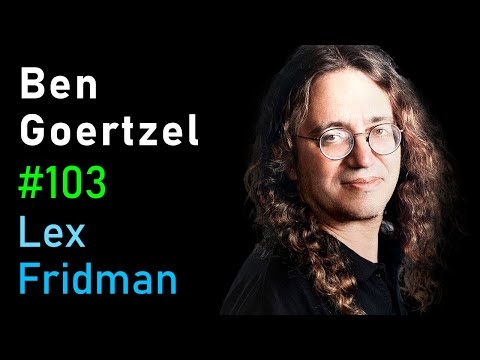
Ben Goertzel: Artificial General Intelligence | Lex Fridman Podcast #103
A four-hour conversation with Lex Fridman — one of the longest in the podcast's catalog — covering the span of Goertzel's work: the OpenCog framework he designed, his years as Chief Scientist of Hanson Robotics and the AI behind the Sophia robot, his role as a central figure in the AGI community and its conference series, and SingularityNET's case for building general intelligence as decentralized infrastructure no single company owns.
View Details
AGI in 5 Years? Ben Goertzel on Superintelligence
A Machine Learning Street Talk interview that opens with Goertzel's disagreement with Ray Kurzweil: both say human-level AGI around 2029, but Kurzweil's 2045 singularity is, in Goertzel's words, 'overfit to having humans do the invention' — once the AGI invents, the exponent changes, and superintelligence follows within a few years. He argues language models' emergent reasoning is real but limited, makes the case for neuro-symbolic hybrids, and describes a design principle from his OpenCog Hyperon system: an intelligence must spend energy on ambient, goal-free processing, because a mind that only pursues its goals overfits to how those goals were phrased. The conversation closes on regulation, which he fears will be both overreaching and too slow.
View Details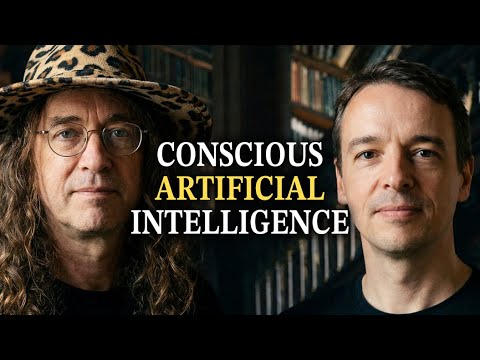
Joscha Bach Λ Ben Goertzel: Conscious Ai, LLMs, AGI
A two-hour 'theolocution' on Theories of Everything whose real shape emerges an hour in, when Bach observes that the two of them 'mostly agree except for crypto' — and names the one deep split: Goertzel is a panpsychist, and Bach cannot formalize panpsychism in a way that differs from plain functionalism. Goertzel's reply is nearly Zen: he doesn't know how to formalize the claim that some things lie beyond all formalization. Along the way they trade Peirce's categories, an anesthetic-based definition of consciousness, and a surprisingly convergent view of LLMs — Goertzel concedes they learn real abstractions, but wants them as subsidiary components of a hybrid AGI, never the hub.
View DetailsConnections

Joscha Bach
In conversationAI Researcher & Cognitive Scientist
Their two-hour 'theolocution' on Theories of Everything — on this site — is billed as a clash and plays as a convergence: an hour in, Bach admits they 'mostly agree except for crypto.' The one deep split it isolates is worth the runtime — Goertzel is a panpsychist who holds that some things lie beyond all formalization; Bach replies that a panpsychism he cannot formalize is indistinguishable from plain functionalism. Even on LLMs they nearly meet: Goertzel concedes the abstractions are real and wants language models as subsidiary components of a hybrid AGI, with something like OpenCog's reasoning at the hub.
youtube.com

Gary Marcus
In conversationCognitive Scientist, AI Critic & Author
A running exchange with an unusual shape: they keep meeting — Marcus's AGI Debate 3 in 2022, a keynote Q&A at Goertzel's AGI-24 conference, a recorded conversation at the World AI Summit 2025 — and they keep agreeing that scaling LLMs will not produce general intelligence, with hybrid neuro-symbolic systems the likelier road. The live seam is everything after that agreement: Marcus reads the gap as a reason for caution and better engineering; Goertzel reads it as a reason to build AGI sooner, differently, and outside corporate walls.
singularitynet.io · garymarcus.substack.com · x.com

Tim Scarfe
In conversationCreator & Host, Machine Learning Street Talk
Goertzel uses the episode to state his disagreement with Ray Kurzweil precisely: Kurzweil puts human-level AGI at 2029 and the singularity at 2045, and Goertzel thinks that sixteen-year gap is an artefact of fitting a curve to human inventors. Once the AGI is doing the inventing — designing its own chips, its own networking — the exponent changes and the gap collapses to a few years. It is a specific, dateable quarrel between two people on this site.
youtube.com

Ray Kurzweil
DebatedInventor, Futurist & Author
They share the near date and split on what follows it. On Machine Learning Street Talk — the interview on this site — Goertzel names 'the big disagreement I had with Ray': both say human-level AGI around 2029, but Kurzweil's 2045 singularity is, in Goertzel's words, 'overfit to having humans do the invention.' Once the AGI itself invents chips and networks, Goertzel argues, the exponent changes and superintelligence follows in years, not decades — a quarrel about whether the curve that made the prediction survives its own fulfillment.
youtube.com

