
Karl Popper
Philosopher of Science
About
Karl Popper (1902–1994) was an Austrian-British philosopher who argued that what separates science from everything else is not that its theories can be proven but that they can be refuted. Born in Vienna and driven abroad by the rise of Nazism, he taught in New Zealand through the war before spending most of his career at the London School of Economics as Professor of Logic and Scientific Method. His criterion of falsifiability recast knowledge as conjecture that has survived testing rather than certainty accumulated from observation, dissolving the problem of induction by denying that science ever needed induction in the first place. In political philosophy, 'The Open Society and Its Enemies' extended the same method to societies, which he held improve by criticism and piecemeal correction rather than by utopian blueprints. He was knighted in 1965 and elected to the Royal Society in 1976; his epistemology is the foundation David Deutsch builds on, which is why arguments about whether machines can create knowledge keep returning to him.
Key Contributions
- Proposed falsifiability as the line between science and non-science: a theory earns its standing by forbidding something, not by collecting confirmations
- Dissolved the problem of induction with conjecture and refutation — theories are guessed rather than derived, then tested for the circumstances that would break them
- Wrote 'The Open Society and Its Enemies', arguing that societies, like theories, improve through criticism and piecemeal reform rather than utopian design
- Developed critical rationalism and the three-worlds account, treating objective knowledge as something that outlives the minds that produced it
- His demarcation criterion remains the working scientist's rule of thumb, though philosophers since Kuhn and Lakatos have argued that real theories are never abandoned on a single failed test
Videos & Interviews
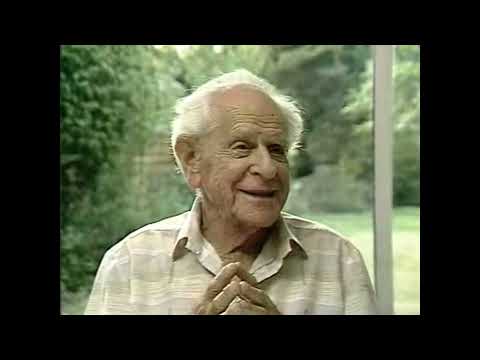
Karl Popper on Falsification & Science (1989)
Popper describes the method as trial and error under conscious criticism: a hypothesis is tested by imagining the circumstances in which it would fail, then arranging those circumstances, so that the weight falls on the error side of trial and error
View Details
Karl Popper on the Open Society (1974)
A German-language interview in which Popper explains what he meant by an open society: one where a person can breathe and think freely, where each individual has worth, and where society imposes no unnecessary coercion. He goes on to fault Western constitutions for leaving parliaments practically omnipotent
View DetailsPapers & Publications

The Logic of Scientific Discovery
1934The book that put falsifiability at the center of scientific method, published in German as 'Logik der Forschung' and translated by Popper himself twenty-five years later
View Book
The Open Society and Its Enemies
1945Written in exile during the war, it reads Plato, Hegel, and Marx as architects of closed societies and defends the open one as the only kind that can correct its own mistakes
View Book
Conjectures and Refutations
1963The essays where the method is stated most plainly: all knowledge grows by bold guesses exposed to serious attempts at refutation
View BookConnections

David Deutsch
InfluencedPhysicist & Pioneer of Quantum Computation
Deutsch is the rare working physicist whose epistemology is wholesale Popper, and he says so without hedging: asked what book humanity would be better off having read, he named Popper's, and 'The Myth of the Framework' in particular, an essay he rereads and gets something new from every time. The inheritance is load-bearing rather than decorative. When Deutsch argues that an LLM is nothing like an AGI, the criterion doing the work is Popper's — knowledge grows by conjecture criticized, not by absorbing what is poured in, which Popper called the bucket theory of the mind. Deutsch's whole case that creativity is the generation of good explanations is Popper carried into physics and computation.
youtube.com · en.wikipedia.org

Plato
DebatedPhilosopher of Classical Athens
Volume one of 'The Open Society and Its Enemies' is titled 'The Spell of Plato', and it is an argument with a man dead two and a half thousand years, written in exile while the war Popper blamed on such thinking was still being fought. He read the Republic as a design for arresting change: history as an illness, justice redefined as class hierarchy, and rule handed to whoever is naturally fit for it. Against the question of who should rule, Popper substituted the one he thought answerable — how to arrange institutions so that bad rulers can be removed without violence. The atlas holds both: Plato's ascent from the cave, and the case that the ascent makes a poor constitution.
en.wikipedia.org

Michael Polanyi
DebatedPhysical Chemist & Philosopher of Tacit Knowledge
Two Central European emigres who arrived at English universities opposing the same things — positivism, totalitarianism — and then spent decades unable to agree on what holds an inquiry together. Polanyi's position was that no falsification is ever quite decisive, since the experiment may be the thing at fault, and that scientists therefore work from frameworks they dwell in rather than doubt; he subtitled 'Personal Knowledge' as 'Towards a Post-Critical Philosophy', with Popper's critical rationalism as the thing being moved past. Popper took the point as an invitation to irrationalism and answered sharply in the 1959 English edition of his own book. The argument is still live wherever people ask whether the tacit judgment of a practitioner is knowledge or merely habit.
polanyisociety.org · Struan Jacobs and Phil Mullins, "Michael Polanyi and Karl Popper: The Fraying of a Long-Standing Acquaintance", Tradition & Discovery 38:2

