
About
Peter B. McCrory is the Chief Economist at Anthropic, where he leads the Economic Research team studying how AI will reshape labor markets and the broader economy. His team publishes the Anthropic Economic Index, a privacy-preserving measure of how people and businesses use Claude across tasks, occupations and countries, and releases its data so outside researchers can study AI's economic effects as they happen. Before Anthropic he was Head of Labor Research at LinkedIn's Economic Graph Research Institute, after working on an applied science team at LinkedIn that used machine learning for marketplace design and causal estimation. He earned his PhD in economics at UC Berkeley and then worked as an economist at JPMorgan, publishing research on US macroeconomic conditions. His public writing includes the essay "Why hasn't AI caused a rise in unemployment?", which argues that diffusion, not capability, sets the pace of AI's economic impact.
Key Contributions
- Leads Anthropic's Economic Research team and the Anthropic Economic Index
- Co-authored 'Estimating AI productivity gains from Claude conversations' (2025), estimating an ~80% task speedup and 1.8% annual US labor-productivity growth
- Co-authored the Economic Index report on uneven geographic and enterprise AI adoption (2025), open-sourcing its data
- Headed labor research at LinkedIn's Economic Graph, building a labor-market-tightness measure from job application data
- Co-authored 'Fiscal Multipliers in the COVID-19 Recession' with Auerbach, Gorodnichenko and Murphy (NBER, 2021)
Videos & Interviews
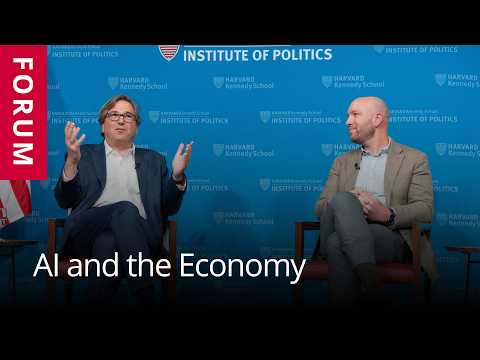
Anthropic’s Chief Economist Breaks Down AI and the Future of the Economy
A JFK Jr. Forum conversation at Harvard's Institute of Politics, moderated by former Council of Economic Advisers chair Jason Furman, on why AI's rapidly rising capabilities have yet to show up in unemployment or productivity data. McCrory explains how his team builds the Anthropic Economic Index from privacy-preserving Claude usage data, why diffusion lags capability, and the open questions of inequality and human-capital formation as students learn with, or lean on, AI.
View Details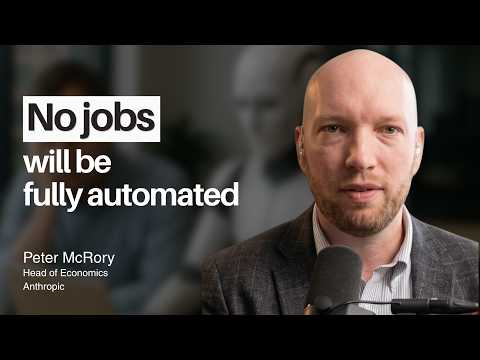
Anthropic Econ: Why AI Has Not Killed Full Employment | Peter McCrory
McCrory walks through his essay "Why hasn't AI increased unemployment?": linking Current Population Survey workers to Claude usage by occupation, he finds no material rise in unemployment even in the most automatable jobs, and reads AI so far as a skill-biased technology that automates some tasks while amplifying human expertise in the loop. He also names the research questions he calls most urgent — the economics of recursive self-improvement, how fast productivity gains arrive, and what happens to markets when AI agents transact on people's behalf.
View DetailsConnections

Dario Amodei
In contrastCEO & Co-founder, Anthropic
In May 2025 Amodei warned that AI could erase half of entry-level white-collar jobs and push unemployment to 10–20% within one to five years. A year on, his own company's economist linked Current Population Survey workers to Claude usage by occupation and found no material rise in unemployment, even in the jobs Claude can most fully automate. The two differ less on mechanism than on timing: McCrory's essay asks only why nothing has shown up yet, and says plainly that the answer could change if the jagged frontier smooths out.
youtube.com · fortune.com

Jack Clark
In conversationCo-founder & Head of Policy, Anthropic
Clark, Anthropic's co-founder and head of public benefit, and McCrory, its head economist, sat down together on Bloomberg's Odd Lots in June 2026 to talk through how the company weighs safety against economic risk, including its preparations for recursive self-improvement. It puts the lab's two public registers side by side: Clark on where capability may be heading, McCrory on what the data says it has done so far.
podcasts.apple.com

Daron Acemoglu
KindredInstitute Professor of Economics, MIT
Describing what he wants his team to do inside Anthropic, McCrory put it 'in the language of the economics literature': can the lab 'operationalize directed technical change,' steering its models toward augmenting labor rather than displacing it? Acemoglu formalized directed technical change in 2002 and has since argued, most fully in Power and Progress, that which way a technology cuts is a choice, not a law. McCrory carries that question inside the company that builds the technology, and admits he does not yet know whether it can be answered there.
youtube.com · Acemoglu, "Directed Technical Change," Review of Economic Studies 69(4), 2002

