
Richard Dawkins
Evolutionary Biologist & Author
About
Richard Dawkins is a British evolutionary biologist born in Nairobi, Kenya in 1941. He rose to prominence with The Selfish Gene (1976), which popularized the gene-centred view of evolution and coined the term 'meme.' He held the inaugural Simonyi Professorship for the Public Understanding of Science at Oxford from 1995 to 2008. His 2006 book The God Delusion became a catalyst of the New Atheism movement, establishing him as one of the most influential public intellectuals in science communication.
Key Contributions
- Popularized the gene-centered view of evolution in The Selfish Gene, changing how many readers understood selection
- Coined meme as a cultural replicator, a concept later transformed by internet culture far beyond his original use
- Developed the extended phenotype argument, treating genes as shaping effects beyond an organism's body
- Served as Oxford's first Simonyi Professor for the Public Understanding of Science
- Used books and lectures to defend evolutionary explanation against creationism and pseudoscience
- His clarity and combativeness made him effective, but his public atheism and culture-war interventions also made him highly polarizing
Videos & Interviews
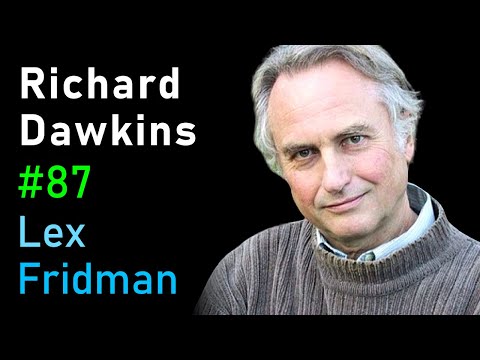
Richard Dawkins: Evolution, Intelligence, Simulation, and Memes | Lex Fridman Podcast #87
Wide-ranging conversation covering evolution, artificial intelligence, simulation theory, and the origins of memes.
View DetailsRichard Dawkins: Why the universe seems so strange
TED talk exploring how our evolutionary frame of reference limits our understanding of the universe.
View DetailsConnections

Charles Darwin
Influenced byNaturalist & Originator of Evolution by Natural Selection
Darwin had the algorithm but not the substrate: he could not say what was inherited, and blending inheritance should have diluted every advantage away within a few generations. The Selfish Gene (1976) supplies the missing piece by moving the unit of selection down to the replicator, leaving organisms as 'survival machines' built by genes to carry them forward. The Blind Watchmaker (1986) then states Darwin's negative claim at its bluntest — a watchmaker that 'does not plan ahead, does not plan consequences, has no purpose in view,' yet whose results impress us with the illusion of design. Dawkins' sharpening is also what let the idea leave biology: once selection is about replicators rather than bodies, memes follow in the same book.
en.wikipedia.org · The Selfish Gene (Oxford University Press, 1976) · en.wikipedia.org · The Blind Watchmaker (Norton, 1986)

Daniel Dennett
InfluencedPhilosopher & Cognitive Scientist
Dawkins spent one late chapter of The Selfish Gene on memes and left them there — a suggestion rather than a program. Dennett picked the suggestion up and made it structural: Consciousness Explained (1991) folded the meme into a theory of the mind, and he kept developing it through Darwin's Dangerous Idea and From Bacteria to Bach and Back, arriving at the claim that 'human consciousness is itself a huge complex of memes.' A self, on that reading, is not what runs the software but what the software builds. It is the clearest claim in the canon that a mind might be constituted by transmissible patterns rather than by whatever substrate happens to be running them — which is the question a language model asks back in reverse.
en.wikipedia.org · Consciousness Explained (Little, Brown and Company, 1991) · en.wikipedia.org · en.wikipedia.org · en.wikipedia.org

Nick Lane
In contrastEvolutionary Biochemist, UCL
Lane is generous about the debt and clear about the departure. Nearly every evolutionary biologist he knows was drawn into the field by the gene's-eye view Dawkins set out in 1976, and Lane grants its central claim outright: nothing but natural selection can build this much complexity. What he disputes is where the account starts. Read life as information and the cell is a vehicle for replicators; read it as energy and the proton gradient comes first, with genes arriving to stabilise a chemistry already running. As Lane puts it, very few biologists now think the gene-centered picture is right as written, even as it still shapes how they think.
youtube.com

