
Sean Carroll
Homewood Professor of Natural Philosophy, Johns Hopkins University
Trace a path from Sean Carroll →About
Sean Carroll is a theoretical physicist and philosopher, Homewood Professor of Natural Philosophy at Johns Hopkins University with joint appointments in Philosophy and Physics & Astronomy, and Fractal Faculty at the Santa Fe Institute. His research runs across quantum mechanics, spacetime, cosmology, and statistical mechanics, including a long-running argument that the Everettian 'many-worlds' reading of quantum mechanics is simply what the equations say when taken seriously. In 'The Big Picture' he set out 'poetic naturalism': there is one natural world, but it can be described truthfully at many different levels, so purpose, meaning, and consciousness can be real without standing outside physics. Since 2018 he has hosted Mindscape, a weekly long-form conversation podcast ranging from black holes to free will to whether a machine could be conscious. He is the author of 'From Eternity to Here', 'Something Deeply Hidden', and 'The Biggest Ideas in the Universe' series.
Key Contributions
- Argues for the Everettian 'many-worlds' interpretation as the most economical reading of quantum mechanics, laid out at book length in Something Deeply Hidden (2019)
- Developed 'poetic naturalism' in The Big Picture (2016) — one world described truthfully at many levels, letting meaning and mind be real without being separate from physics
- Co-authored the Carroll–Chen proposal (2004), deriving the thermodynamic arrow of time from spontaneous eternal inflation in an empty de Sitter background
- Hosts Mindscape (since 2018), a weekly podcast of long-form conversations across physics, philosophy, biology, and the questions AI raises about mind and understanding
- Wrote the graduate textbook Spacetime and Geometry (2003); won the Royal Society Winton Prize (2013) for The Particle at the End of the Universe, the Andrew Gemant Award (2014), and a Guggenheim Fellowship (2015)
Books


Videos & Interviews
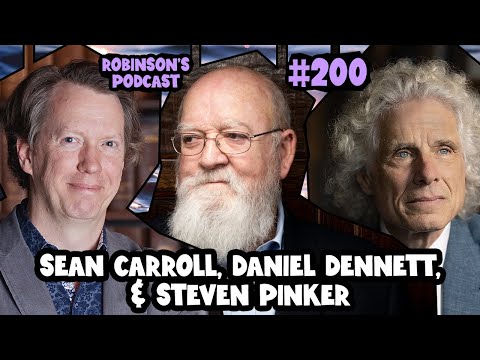
Sean Carroll, Daniel Dennett, & Steven Pinker: AI, Parapsychology, Panpsychism, & Physics Violations
A wide-ranging discussion with physicist Sean Carroll, philosopher Daniel Dennett, and cognitive scientist Steven Pinker on AI, parapsychology, panpsychism, and what would count as a violation of physics.
View Details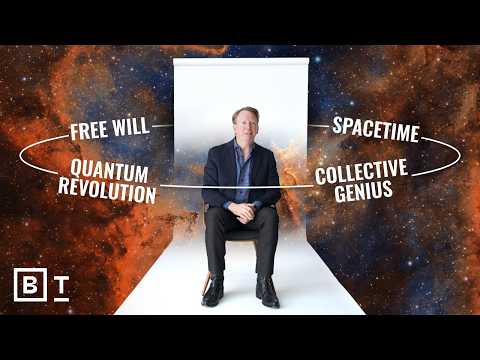
Sean Carroll explains the biggest ideas in the universe | Full Interview
Big Think full interview walking the whole arc of modern physics in four chapters — free will and Laplace's demon, the invention of spacetime, the quantum revolution, and the measurement problem — closing on why the big theories came from collective genius rather than lone geniuses. Carroll's opening line is the thesis: physics is hard because physics is easy.
View Details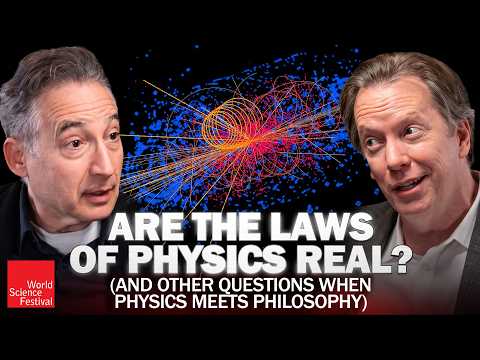
Exploring the Deep Mysteries of Physics | World Science Festival
Brian Greene sits down with Sean Carroll on whether the laws of physics are discovered or invented, why Carroll thinks the many-worlds reading of quantum mechanics is the honest one, and what follows for free will, consciousness, and whether an AI could ever be either.
View DetailsConnections

David Chalmers
In contrastPhilosopher of Mind
The cleanest live disagreement about whether consciousness needs an extra ingredient. Chalmers holds that even a complete physical story leaves the felt quality of experience unexplained — the Hard Problem — while Carroll's poetic naturalism says the physical story is the whole story, and that experience is a higher-level description of it, real in the way temperature is real. They talked it through on Mindscape in 2018, zombies and all, and neither moved. The same fork decides how you read a language model: a system that lacks the extra ingredient, or a system described at the wrong level.
preposterousuniverse.com

Daniel Dennett
KindredPhilosopher & Cognitive Scientist
Two versions of the same deflationary move. Dennett explains consciousness by explaining away the demand for an inner theater; Carroll's poetic naturalism explains meaning and purpose by granting that many vocabularies can be true of one world, each at its own level. Both refuse the extra ingredient without denying that the thing being described is real — a position that is easy to mistake for eliminativism and is not. They appear together, with Steven Pinker, in a recorded panel on this site.
youtube.com

Carlo Rovelli
In contrastTheoretical Physicist & Author
Both take the quantum formalism at face value and arrive at opposite pictures. Carroll reads the wave function as the thing that exists, evolving smoothly, which leaves you with many worlds. Rovelli's relational interpretation drops the idea of an absolute state altogether: properties exist only relative to an interaction, so there is nothing left over to branch. Rovelli was the second guest Carroll ever had on Mindscape, and the disagreement is still the most interesting one in the field.
preposterousuniverse.com

Leonard Susskind
In conversationTheoretical Physicist, Stanford
On Mindscape in 2019, Carroll — who introduces him as a leader in reconciling general relativity with quantum mechanics — draws out the ideas Susskind is known for: black hole complementarity, the hologram, the landscape. The richest thread is the newest: Susskind's claim that the computational complexity of a black hole's evolution has a direct geometric meaning, the volume of its interior.
preposterousuniverse.com

